
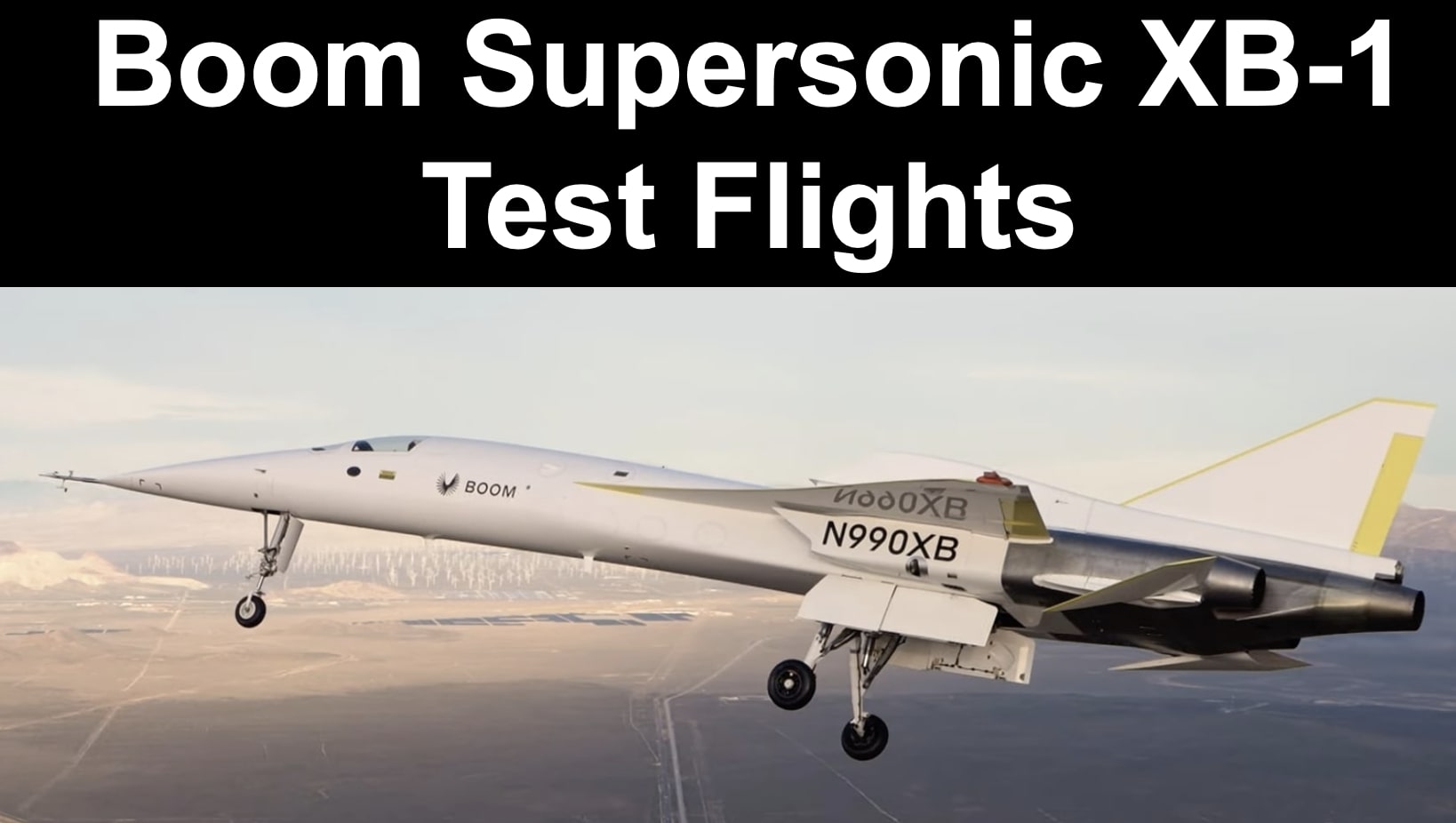
The Boom XB-1 Baby Boom is a one-third-scale trijet supersonic demonstrator designed by Boom Technology as part of development of the Boom Overture supersonic transport airliner. It is powered by three General Electric J85s, it is planned to maintain Mach 2.2, with over 1,000 nautical miles.
The XB-1 took its first flight on March 22, 2024, flown by Chief Test Pilot Bill Shoemaker from Mojave Air and Space Port.
On April 16, 2024, the FAA issued a special license for the XB-1 to exceed Mach 1 at the nearby Black Mountain Supersonic Corridor. Test flights to Mach 1.1, 1.2 and 1.3 are planned for later in 2024.
On August 26, 2024, the XB-1 lifted off from Mojave, California, for its second test flight, piloted by chief test pilot Tristan Brandenburg.
The XB-1 Baby Boom is 68 feet (21 m) long with a 17 ft (5.2 m) wingspan and a 13,500-pound (6,100 kg) maximum take-off weight.
In 2022, the Overture was redesigned to a quadjet configuration.
Boom Funding Towards a Commercial Supersonic Passenger Plane
Boom claims to have raised over $700m from mostly undisclosed angel investors and also recently from Saudi Arabia NEOM.
In January 2019, Boom raised a further $100 million, bringing the total to $151 million, then planning the demonstrator first flight for later in 2019.
In January 2022, the company announced plans to build a 400,000 square feet (37,161 square meter) manufacturing facility on a 65 acres (263,046 m2) site at Piedmont Triad International Airport in Greensboro, North Carolina.
In November 2023, a representative of the NEOM Investment Fund announced their investment in Boom at an undisclosed amount.
Supersonic Passenger Plane 2030-2035
The Boom Overture is a proposed Mach 1.7 (1,000 kn; 1,800 km/h; 1,100 mph), 65- to 88-passenger supersonic transport with a planned 4,250 nmi (7,870 km; 4,890 mi) of range. They will have 500 viable routes. Boom suggests there could be a market for 1,000 supersonic airliners with business class fares. They had gathered 76 commitments by December 2017 and another 35 from United and American Airlines in 2021 and 2022.
Boom CEO Blake Scholl estimates that flights on Overture will be available in 2030.
In December 2022, Boom announced the Symphony, a new propulsion system to be designed for the Overture.
Boom Supersonic is participating in a NASA-led study to develop concept designs and technology roadmaps for a Mach 4 airliner. Boom is part of a team led by Northrop Grumman Aeronautics Systems, alongside Blue Ridge Research and Consulting and Rolls-Royce North American Technologies.

Brian Wang is a Futurist Thought Leader and a popular Science blogger with 1 million readers per month. His blog Nextbigfuture.com is ranked #1 Science News Blog. It covers many disruptive technology and trends including Space, Robotics, Artificial Intelligence, Medicine, Anti-aging Biotechnology, and Nanotechnology.
Known for identifying cutting edge technologies, he is currently a Co-Founder of a startup and fundraiser for high potential early-stage companies. He is the Head of Research for Allocations for deep technology investments and an Angel Investor at Space Angels.
A frequent speaker at corporations, he has been a TEDx speaker, a Singularity University speaker and guest at numerous interviews for radio and podcasts. He is open to public speaking and advising engagements.
This is interesting. From what I understand commercial SST’s (from designs from the 1970’s) never took off because the sonic booms they created (then) rattled the China and broke peoples windows. Well they did. Sometimes rather shockingly. That’s because “sonic booms” you notice, are a serious pain in the ass, more so when it causes damage to your property. Not because they affect you personally, (honestly they don’t affect any person or animal beneath them), but if “they” break anything among, within, or close to any living person who gives a s*** to notice? LAWSUIT, lawsuit,. New supersonic technologies will eliminate (most of) the sonic boom. Does that mean lawyers will find less things to sue about? Oh, please…
Current plan is only supersonic over the ocean or larger lakes. 750 mph or whatever air conditions allow for just barely subsonic. Still 20% faster than other planes. 3X more fuel efficient than Concord. 25% ticket price of $5000 vs $20,000.
Sorry Brian, but a plane will not be economical if it can’t fly over populated, occupied land. Are you serious? Big lakes? There’s only one lake Superior and one lake Baikal in Russia the two biggest freshwater bodies on Earth. What you say, does not make sense. I don’t care how fast a single plane can go. Many planes need to do that, and still make everything else work “very cleanly”, to make it all “sweet”. Hey it’s in the end quite simple, but also complicated. Simple it should be to get on a commercial flight to go anywhere on Earth, and notice nothing.
Complicated, because it takes thousands of people, doing many things every day, to get us to wherever we want to go, and we almost always notice, nothing at all. As it should be.
New NASA designs (and others) have airframe designs that DO NOT cause classic sonic booms. More a burp, then a boom. The fact Concord could not fly over land, doomed it economically. Even before fuel prices soared in the 1970’s. Concord was a brilliant technological achievement, the best 1960’s technology could produce. They designed it with slide rules (pocket calculator’s didn’t exist until the invention of the integrated circuit, in 1971). But damn, that was one hell of an aircraft. But by causing sonic booms flying over land breaking things and costing people money, not to mention having your cat, go bald from stress (think kitty shedding is A PROBLEM NOW?). They did the math, and said “ain’t worth it”.
I admire British Airways and Air France for turning the uneconomical Concord into a status symbol. Bragging rights? Perhaps. When I flew on Concord it was very anticlimactic. Which I think every airline hopes for every passenger. (By the way, the food was fabulous)