
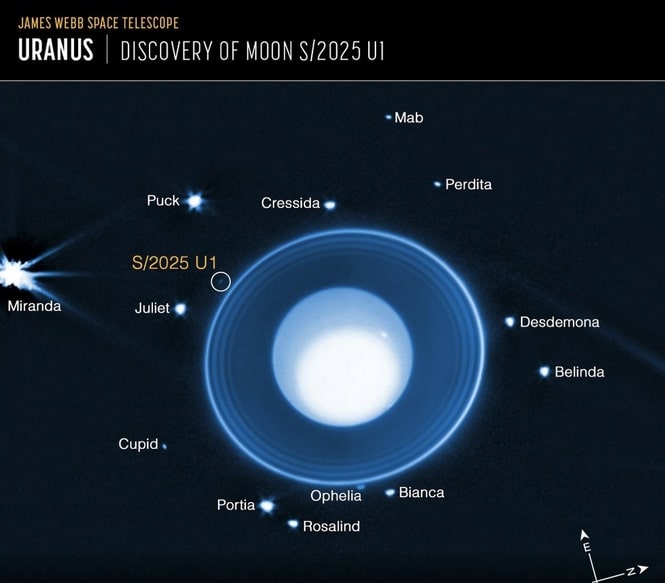
Using NASA’s James Webb Space Telescope, a team led by the Southwest Research Institute (SwRI) found a previously unknown moon orbiting Uranus, expanding the planet’s known satellite family to 29. The detection was made during a Webb observation Feb. 2, 2025.
The newly discovered moon is estimated to be just six miles (10 kilometers) in diameter, assuming it has a similar reflectivity (albedo) to Uranus’ other small satellites. That tiny size likely rendered it invisible to Voyager 2 and other telescopes.
The new moon is the 14th member of the intricate system of small moons orbiting inward of the largest moons Miranda, Ariel, Umbriel, Titania, and Oberon. (All the moons of Uranus are named after characters from Shakespeare and Alexander Pope.)
“It’s located about 35,000 miles (56,000 kilometers) from Uranus’ center, orbiting the planet’s equatorial plane between the orbits of Ophelia (which is just outside of Uranus’ main ring system) and Bianca,” said El Moutamid. “Its nearly circular orbit suggests it may have formed near its current location.”

Brian Wang is a Futurist Thought Leader and a popular Science blogger with 1 million readers per month. His blog Nextbigfuture.com is ranked #1 Science News Blog. It covers many disruptive technology and trends including Space, Robotics, Artificial Intelligence, Medicine, Anti-aging Biotechnology, and Nanotechnology.
Known for identifying cutting edge technologies, he is currently a Co-Founder of a startup and fundraiser for high potential early-stage companies. He is the Head of Research for Allocations for deep technology investments and an Angel Investor at Space Angels.
A frequent speaker at corporations, he has been a TEDx speaker, a Singularity University speaker and guest at numerous interviews for radio and podcasts. He is open to public speaking and advising engagements.
Why do they give moons around a planet names? Why not a number?
The gas giant moons look to me like a good candidate for 3rd wave colonization efforts.
I distinguish colonization waves by the propulsion technology required to make them feasible.
The first wave are the destinations that are feasible using chemical propulsion. Starship, basically. Chemical rocketry can deliver high accelerations, but is limited in the available delta V. So you need destinations that are ‘nearby’ in terms of delta V, where aerobraking helps.
The Moon, just because it’s so close. Mars, feasible delta V and available aerobraking. Possibly Venus; The delta V requirements are similar to Mars, also aerobraking available, but the necessity of colonizing the upper atmosphere rather than the surface adds enough difficulty I think that’s more of a 2nd or 3rd wave destination.
The second wave are destinations that as a practical matter exceed what chemical rocketry can supply. They’re not impossible with chemical rockets, but the payload fraction is terribly low, and you don’t have the advantage of aerobraking. The asteroids. These are good candidates for the use of a combination of PV power and ion propulsion; Better ISP, but you can’t supply high acceleration, and so can’t land on bodies with significant surface gravity.
The third wave are destinations nuclear propulsion, with its combination of high ISP and acceleration would enable. Mercury, the moons of the gas giants. Here we’re starting to get into destinations people would chose because they want some serious privacy.
The fourth wave are destinations that require higher end nuclear propulsion to get decent trip times. Kuiper belt objects, primarily. But the gas giant moons are where we’ll learn the techniques necessary to live there.
This newly discovered moon of Uranus really falls into the second wave, due to its low surface gravity you could reach it without high accelerations. And I believe Uranus doesn’t have the nasty radiation environment you find around Jupiter, that makes its moons hard to access.
In principle, of course, you could colonize the atmospheres of the gas giants other than Jupiter using the same ‘cloud city’ techniques you’d use for Venus, except for the requirement that your lifting gas be heated. But the delta v to leave again would be pretty awful.