
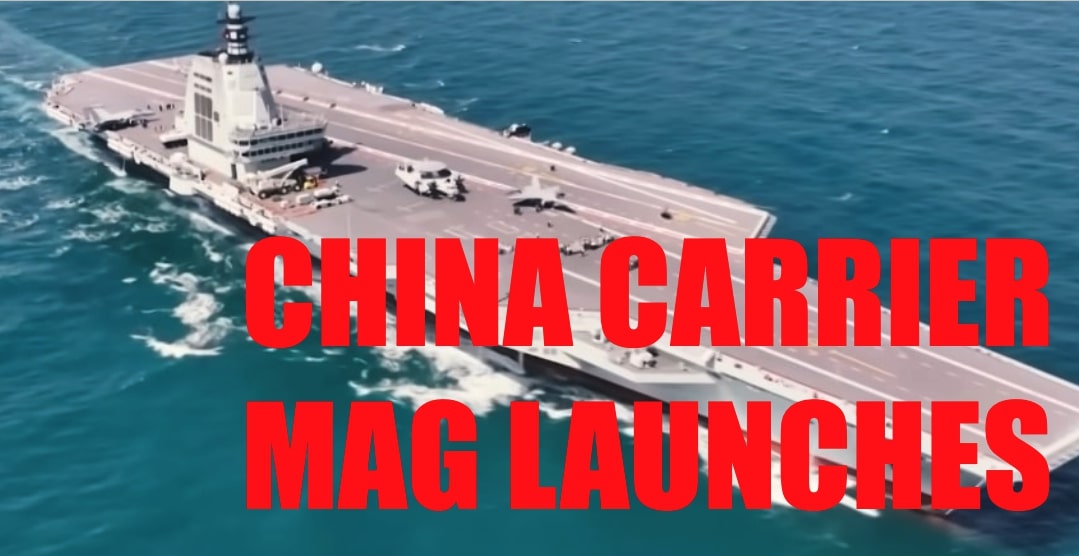
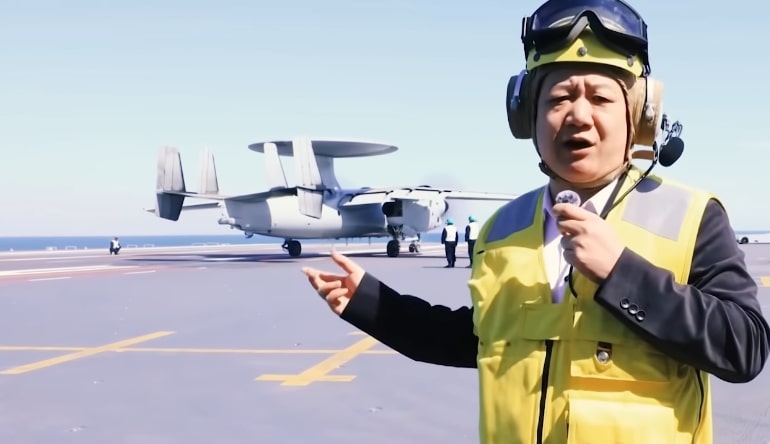
Xinhua News Agency reports that the Chinese navy has had take off arrested landing tests of the J-15T, J-35 fighter jets and the KJ-600 early warning and command aircraft with a electromagnetic catapult on the new Fujian aircraft carrier.
The CNS Fujian is a Type 003 and is the China’s most advanced aircraft carrier. Video above shows the first successful electromagnetic catapult-assisted takeoffs (via EMALS) and arrested landings of carrier-based aircraft, The J-15T is a multirole fighter with an upgraded variant with catapult compatibility. The J-35 stealth fighter and the KJ-600 fixed-wing early warning aircraft.
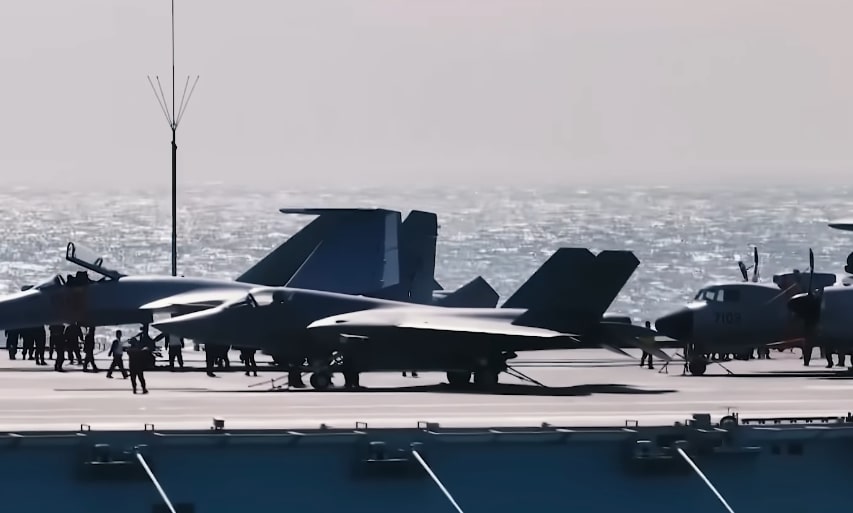
China is transitioning from ski-jump Short Take-Off But Arrested Recovery (STOBAR) systems on its earlier carriers to full Catapult-Assisted Take-Off But Arrested Recovery (CATOBAR) operations, enabling heavier payloads, fuller fuel loads, and broader aircraft integration.
The PLAN has the world’s largest navy by hull count (over 370 warships) describes this as a leap in blue-water projection capabilities.
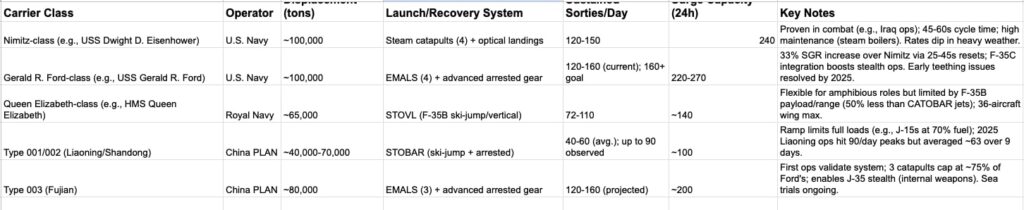
The PLAN’s carrier fleet (now 3 operational, with Fujian commissioning by late 2026) lags the U.S.’s 11 supercarriers in power, but per-ship efficiency is getting closer.
EMALS allows Fujian to launch stealthy, sensor-fused air wings (e.g., 40-50 aircraft: 24 J-15T/J-35s, 4 KJ-600s, helicopters), projecting ~1,000 nm strikes with 20-30% higher combat loads than STOBAR predecessors.
This swill start shifting navy power at some point but the US still outclasses China.
In a Taiwan scenario, Fujian could sustain 1,200-1,500 sorties/week, contesting U.S. air superiority where Liaoning/Shandong managed ~300-400.Versus U.S. platforms, Nimitz remains the reliability benchmark—its steam system, while archaic, powers relentless ops (e.g., 120+ sorties in Red Sea 2024). Ford’s EMALS, battle-tested by 2025, edges ahead with modular upgrades (e.g., AI-optimized deck ops), targeting 200+ sustained rates via software tweaks. British QE-class, optimized for NATO coalitions, punches below weight: STOVL caps F-35B at subsonic, light loads, yielding 40-50% fewer effective strikes than CATOBAR peers—ideal for littoral defense but not blue-water dominance.
China next Type 004 will start to get in the size and power as one of the 11 US carriers. It should be nuclear-powered, ~100,000 tons, expected 2028-2030 and will feature 4 EMALS catapults and conventional take-off/landing (CTOL) for drones, pushing rates to 180-220/day. The U.S. plans 10 Ford-class by 2035, with NGAD integration for hypersonic edges. Britain eyes CATOBAR retrofits for QE (F-35C swaps by 2030s), but budget constraints limit to 110-140 rates. Overall, China’s build rate (1 carrier/2-3 years) outpaces the West, but doctrinal gaps persist—U.S. CSGs integrate submarines/AEW for 3x force multiplication.

Brian Wang is a Futurist Thought Leader and a popular Science blogger with 1 million readers per month. His blog Nextbigfuture.com is ranked #1 Science News Blog. It covers many disruptive technology and trends including Space, Robotics, Artificial Intelligence, Medicine, Anti-aging Biotechnology, and Nanotechnology.
Known for identifying cutting edge technologies, he is currently a Co-Founder of a startup and fundraiser for high potential early-stage companies. He is the Head of Research for Allocations for deep technology investments and an Angel Investor at Space Angels.
A frequent speaker at corporations, he has been a TEDx speaker, a Singularity University speaker and guest at numerous interviews for radio and podcasts. He is open to public speaking and advising engagements.