

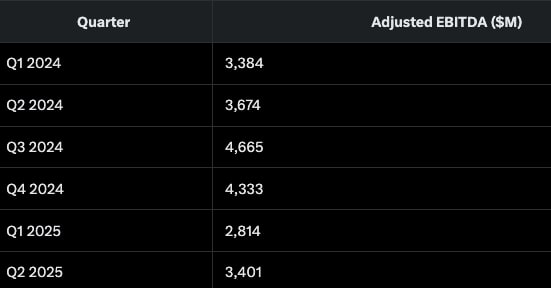
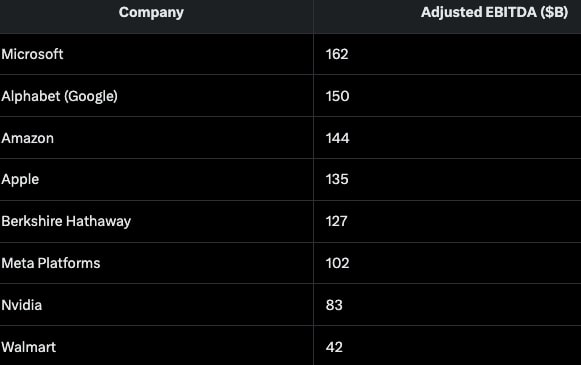
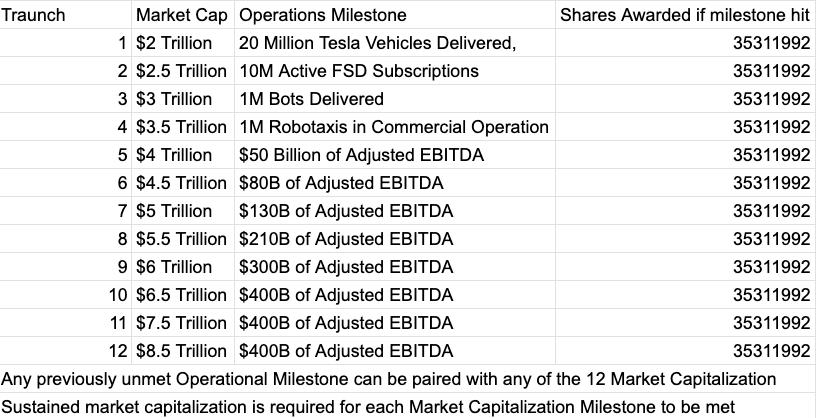
Everyone is misunderstanding the 2025 TESLA CEO Pay Plan. It is a $20 Trillion Plan NOT $8.5 Trillion market capitialization target. Adjusted EBITDA is a better measure of true company earnings without one time charges. Tesla having fast growth to 25 times more adjusted EBITDA will be five times more “true profitability” than Nvidia. Fast growth to give times more profit means a $20 trillion valuation and not nvidia current $4-4.5 trillion
Adjusted EBITDA is generally considered a more accurate measurement of a company’s ongoing profit potential than raw EBITDA or net income, especially for long-term valuation and performance assessment. This is because adjusted EBITDA removes non-recurring, exceptional, or non-operational items, offering a clearer view of a company’s core earnings that are sustainable over time.
Tesla giving Elon Musk a goal of creating more adjusted EBITDA than any company ever and holding it for 36 months would ensure that Tesla will reach over $20 trillion in valuation.
Tesla reaching that goal within 7-10 years would require fast growth from $15 billion to 25 times more at $400 billion. The number is five times more than Nvidia $83 billion Adjusted EBITDA and Nvidia is worth $4-4.5 trillion in market value today.
Achieving the Adjusted EBITDA (aka non-gamed profit) target of $400 billion per year for three years will require over 10 million robotaxi and Teslabots each producing about $40,000-50,000 of earnings each year per physical AI machine.

Brian Wang is a Futurist Thought Leader and a popular Science blogger with 1 million readers per month. His blog Nextbigfuture.com is ranked #1 Science News Blog. It covers many disruptive technology and trends including Space, Robotics, Artificial Intelligence, Medicine, Anti-aging Biotechnology, and Nanotechnology.
Known for identifying cutting edge technologies, he is currently a Co-Founder of a startup and fundraiser for high potential early-stage companies. He is the Head of Research for Allocations for deep technology investments and an Angel Investor at Space Angels.
A frequent speaker at corporations, he has been a TEDx speaker, a Singularity University speaker and guest at numerous interviews for radio and podcasts. He is open to public speaking and advising engagements.
Many people have a problem with accounting and its concepts.
1. GDP is more comparable to EBITDA. GDP is like a company’s gross earnings. except as applied to a country.
2. If you wish to make a true comparison, you should look at the American Taxpayer as a shareholder of the United States of America. The value of the assets of U.S. citizens are as follows:
As of the first quarter of 2025, the total value of assets held by all United States citizens (primarily through households and nonprofit organizations, including noncorporate businesses) and corporations (nonfinancial and financial sectors) is approximately $427.1 trillion.
$427 Trillion
4 sources:
1. The first figure is derived from the Federal Reserve’s Financial Accounts of the United States (Z.1) and represents the aggregate of:Households and nonprofit organizations: $190.1 trillion (includes personal real estate, consumer durables, financial holdings, and equity in noncorporate businesses).
2. Nonfinancial corporate businesses: $63.8 trillion (includes inventories, equipment, intellectual property, real estate, and financial assets).
3. Nonfinancial noncorporate businesses: $28.3 trillion (includes real estate, equipment, and financial assets; these are typically small businesses like partnerships and sole proprietorships owned by citizens).
4. Domestic financial sectors: $144.9 trillion (primarily financial assets like loans, securities, and deposits held by banks, insurers, pension funds, and other financial institutions).
Note that this total encompasses both tangible/nonfinancial assets (e.g., property, equipment) and financial assets (e.g., stocks, bonds, deposits), with some inter-sector holdings (like household ownership of corporate equities) reflected in the sectoral breakdowns to avoid overstating the aggregate. It excludes government-held assets and focuses on private sector holdings by U.S. residents and entities. More recent data for Q2 2025 may be available but was not yet fully released as of early September 2025.
It is from all those assets that the U.S. government, and its proxy (the U.S. dollar) obtains its value. When we say the dollar is backed by the full faith and trust of the U.S. government, what we are actually saying is the dollar is backed by the full faith and trust of the U.S. taxpayer.
Every government and financial institution in the world understands this. It is why the U.S. dollar is by far the most valued currency in the world.
This estimate is probably too low. According to Grok, The value of unimproved land is frequently missed in discussions about the value of America. It is $27t-$30t according to the most reliable calculations by the Bureau of Economic Statistics, and after excluding $2t/28% in federal land (probably too low, considering potential future uses of such land not currently allowed/done).
https://x.com/NewThinking2/status/1964600001012629901
The real question is how much of those assets are liquid and available to buy stock, without incurring various forms of debt, e.g. margin, derivatives (worth between $800t – $1.3 quadrillion, depending on whose estimates you choose, though it’s half that if you assume that for every buyer of one position there is someone with a position on the other side), etc. If you stripped out all the debt, you’d probably find there’s very little in the stock market already, let alone more to invest.
OTOH, there’s value we don’t currently tax while untaxing other values that would boost productivity, like taxes on wages and improvements to land (buildings etc.) to compensate, like unimproved land ($27t-$30t according to the BEA. See previous comment).
To better understand the absurdity of such a plan, please note that the USA’s gross domestic product in 2025 is approximately 30 trillion dollars
1. GDP is more comparable to EBITDA. GDP is like a company’s gross earnings. except as applied to a country.
2. If you wish to make a true comparison, you should look at the American Taxpayer as a shareholder of the United States of America. The value of the assets of U.S. citizens are as follows:
As of the first quarter of 2025, the total value of assets held by all United States citizens (primarily through households and nonprofit organizations, including noncorporate businesses) and corporations (nonfinancial and financial sectors) is approximately $427.1 trillion.
$427 Trillion
4 sources:
1. The first figure is derived from the Federal Reserve’s Financial Accounts of the United States (Z.1) and represents the aggregate of:Households and nonprofit organizations: $190.1 trillion (includes personal real estate, consumer durables, financial holdings, and equity in noncorporate businesses).
2. Nonfinancial corporate businesses: $63.8 trillion (includes inventories, equipment, intellectual property, real estate, and financial assets).
3. Nonfinancial noncorporate businesses: $28.3 trillion (includes real estate, equipment, and financial assets; these are typically small businesses like partnerships and sole proprietorships owned by citizens).
4. Domestic financial sectors: $144.9 trillion (primarily financial assets like loans, securities, and deposits held by banks, insurers, pension funds, and other financial institutions).
Note that this total encompasses both tangible/nonfinancial assets (e.g., property, equipment) and financial assets (e.g., stocks, bonds, deposits), with some inter-sector holdings (like household ownership of corporate equities) reflected in the sectoral breakdowns to avoid overstating the aggregate. It excludes government-held assets and focuses on private sector holdings by U.S. residents and entities. More recent data for Q2 2025 may be available but was not yet fully released as of early September 2025.
The collective market cap of the Mag7 right now is about $20T in a year when U.S. GDP is $30T. This is projecting out through ten years of AI/Robotics growth in The Singularity. What’s the absurdity?