
Oklo’s market capitalization has ballooned to $25 billion. The NRC denied Oklo’s custom combined license application in Jan 2022, citing insufficient information on maximum-credible-accident (MCA) analyses, safety classification of SSCs (systems/structures/components), QA implementation, and other key technical topics. The denial and associated letters are public. Oklo has since restructured its licensing approach and reengaged the NRC with a new design.
Can Oklo convert its frothy market cap into a credible success path? Technically yes but it is unlikely. Oklo faces hard regulatory liabilities (NRC rework), technical and licensing risk, limited operational track record, and an enterprise with relatively little revenue. A buyer would pay for the future pipeline, regulatory progress, and IP / talent. There are many other nuclear energy competitors. Oklo would also have issues buying another nuclear company that would have designs or technology that could be developed.
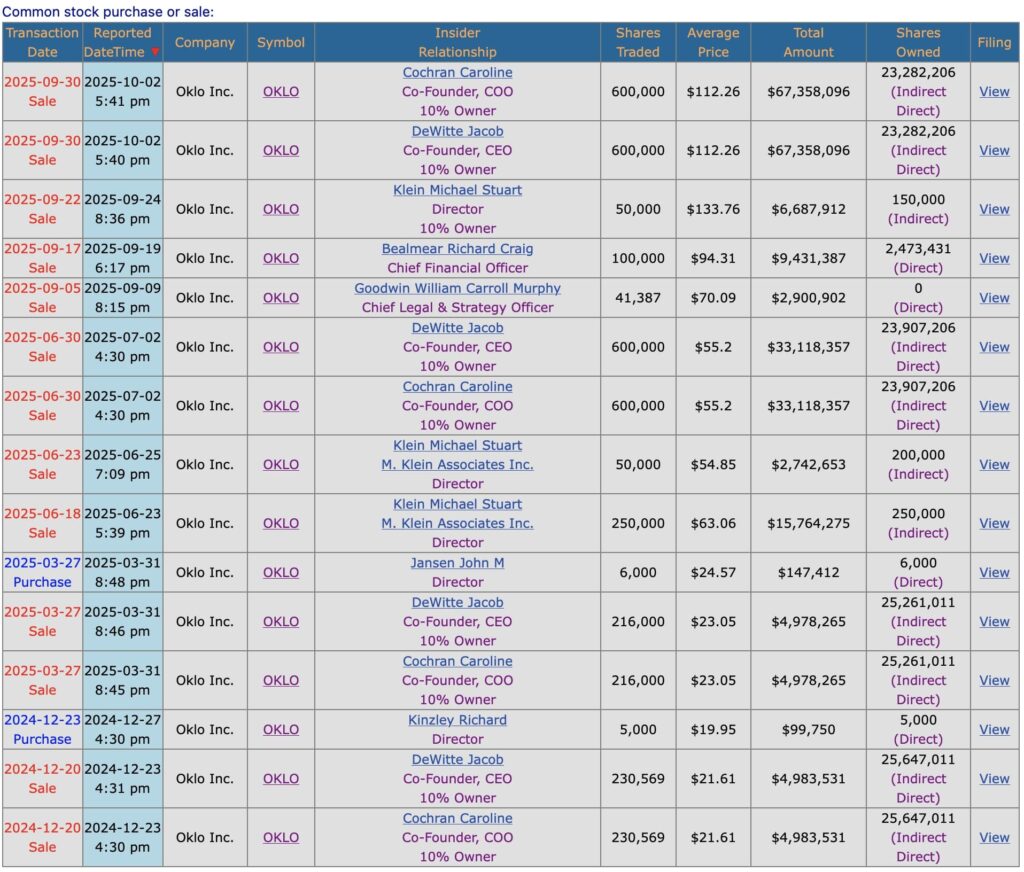
Founders Jacob DeWitte and Caroline Cochran reporting multiple stock sales in 2024–2025. The CFO exercised and sold option-derived shares in Sept 2025.
There have been about $250 million in sales by insiders.
They plan to make a range of fast nuclear reactors with power up to 75 Megawatts. The Oklo Aurora powerhouse, is a liquid metal-cooled (sodium-cooled) fast neutron reactor. The Aurora’s non-pressurized, compact design is intended to be simpler and faster to construct than legacy gigawatt-scale light-water reactors, relying heavily on factory-fabricated modules.
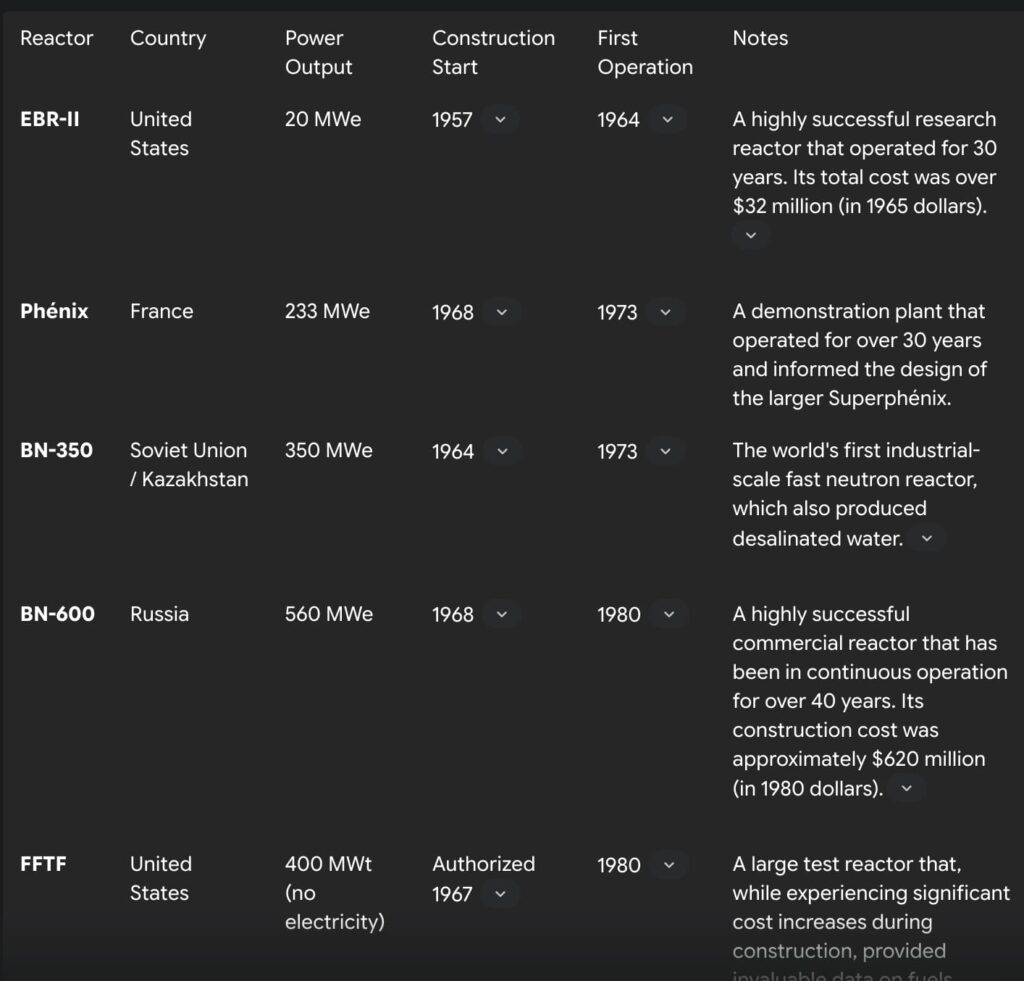
The Russians built commercial lead fast nuclear reactor and a sodium fast nuclear reactors. They operated commercially but they were not built with exceptional construction times. They were not lower cost.
Phénix (France): Construction on the Phénix demonstration plant began in November 1968, and it was first connected to the French national electricity grid in December 1973. Construction and connection period took five years.
BN-600 (Soviet Union/Russia): Construction of the BN-600 power unit started in 1968. The reactor achieved first criticality in February 1980 and was connected to the grid in April 1980. Construction and connection took 12 years.
The Superphénix 1.2 GWe reactor was the largest fast breeder reactor ever constructed. Construction began in 1976 and was connected to the grid about 11 years later. Its operational history was troubled. It faced significant cost overruns, public protests, and recurring technical issues, including leaks in its liquid sodium cooling system. It operated at full power for a total of only 278 days during its lifetime and cost $10 billion. It was permanently shut down for economic reasons in 1997 and its dismantling began in 1999.
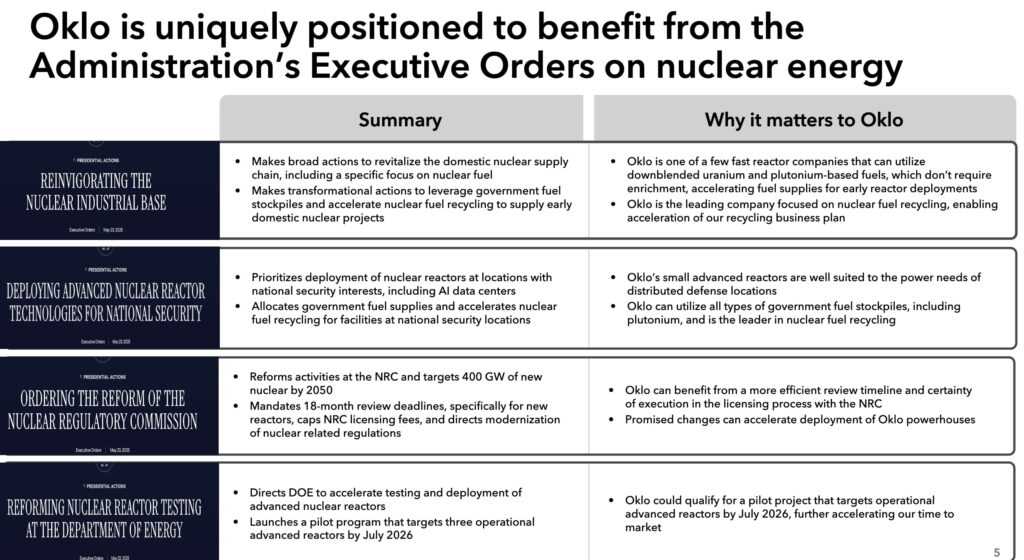
They are in DOE pilot programs and have INL cooperation plus HALEU access. Oklo can plausibly field an in-lab demonstration or DOE-authorized pilot at INL within ~24–36 months — if the NRC/DOE authorization process for pilot booths runs smoothly. This is dependent on NRC/DOE process and how well Oklo addressed the 2022 rejection issues).
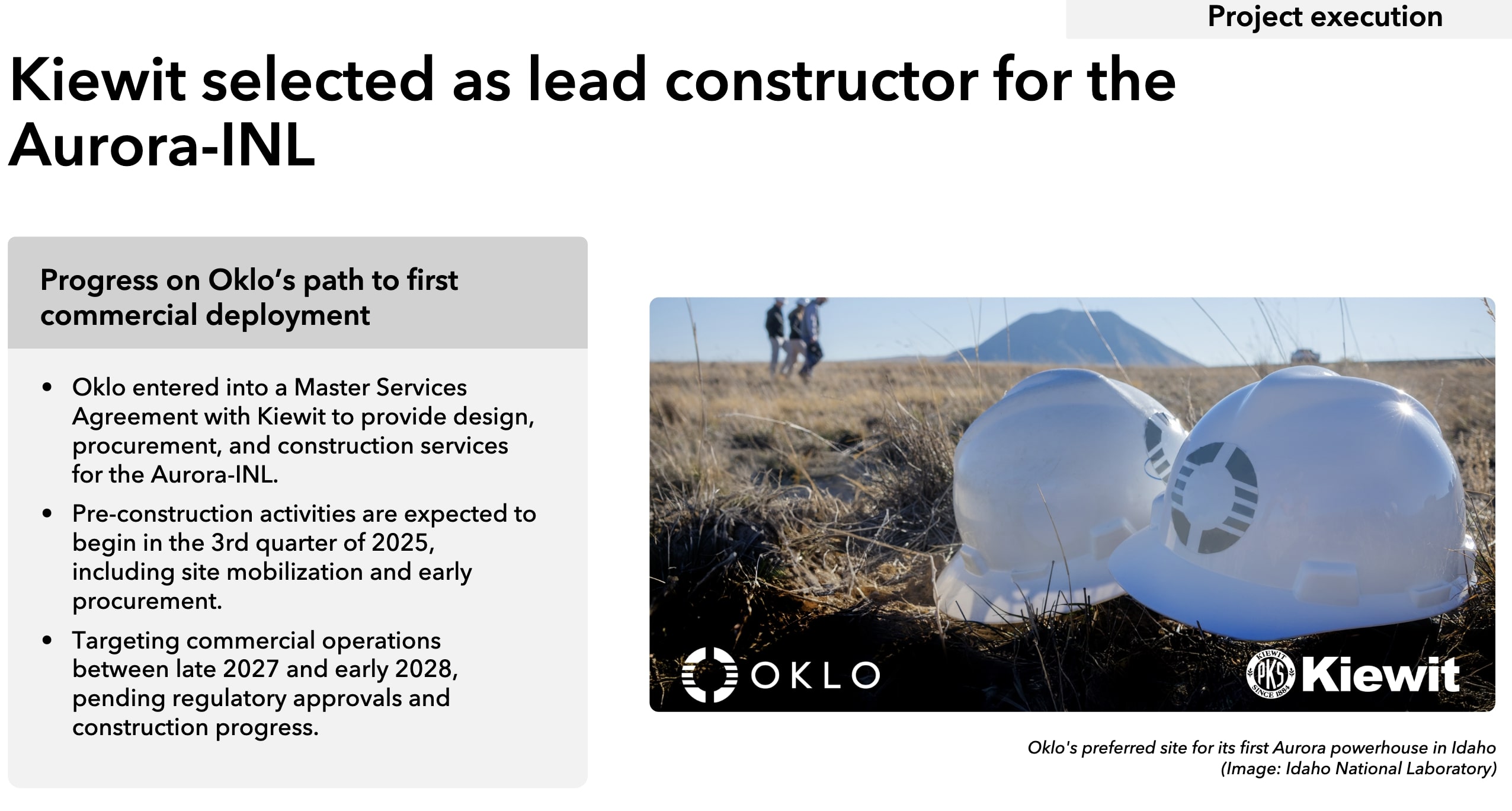
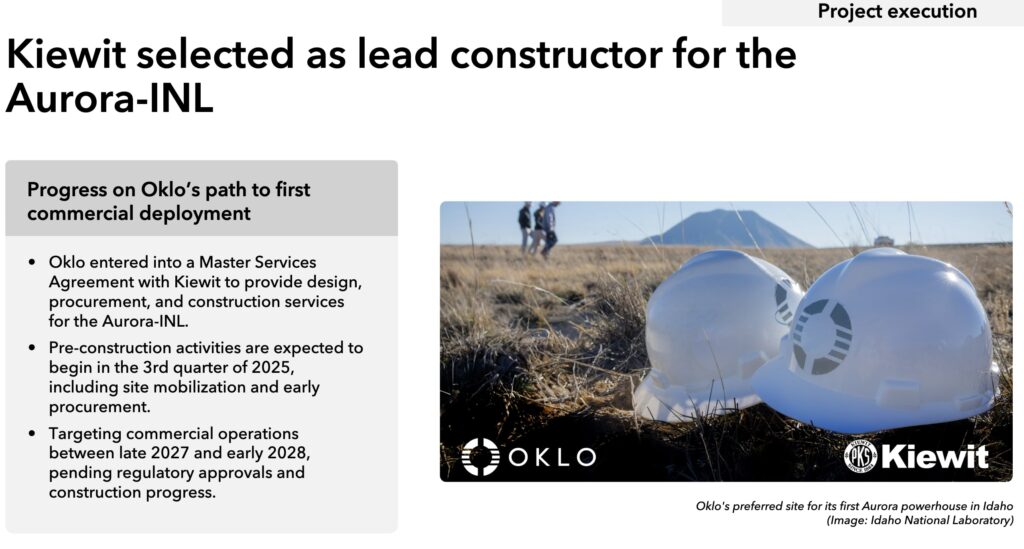
The earliest credible commercial generation from Oklo at INL (Idaho National Lab) is late-2027 to 2028 for a DOE-backed demonstration or pilot and later for commercial deployments.
Kiewit brings strong execution, delivering large industrial/infrastructure & some nuclear adjacent civil/structural work. Helps with non-nuclear components, permitting, supply chain of large equipment/licenses etc.
KHNP has experience putting together conventional large reactor builds, integrating systems, plant operations and regulatory compliance.
OKLO has to recreate and build fast nuclear reactor from designs into actual working reactors. Fast nuclear reactors have been built before. OKLO needs to execute on building a smaller advanced reactor on time and budget.
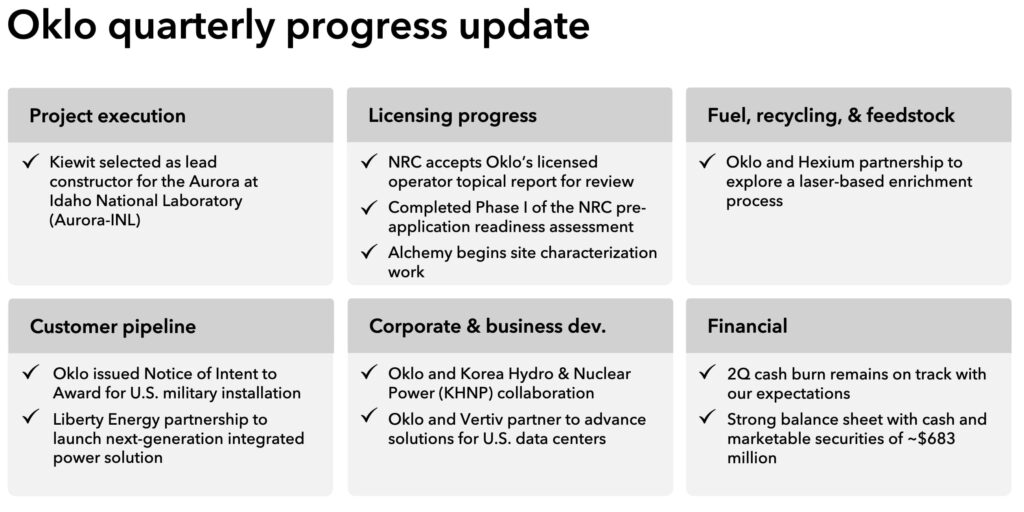
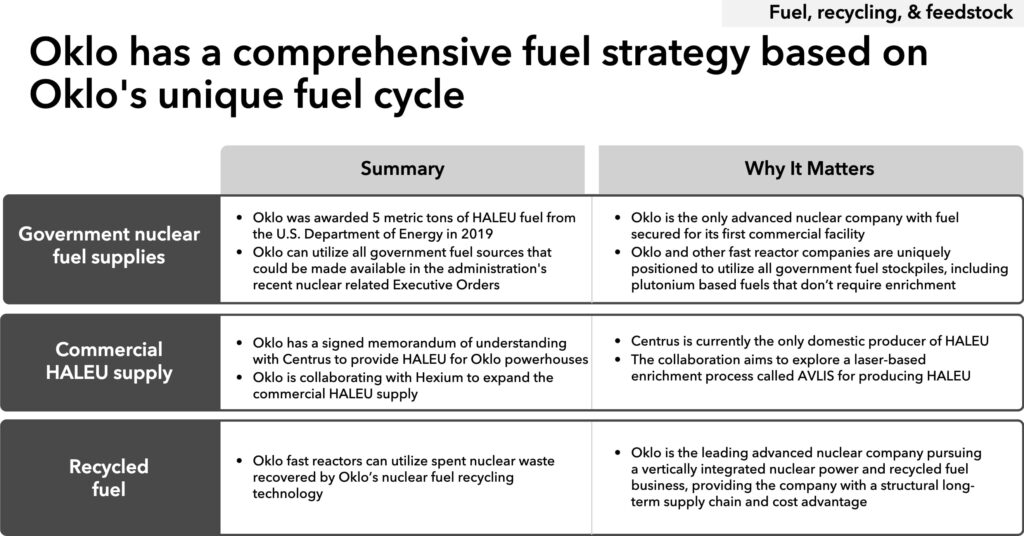
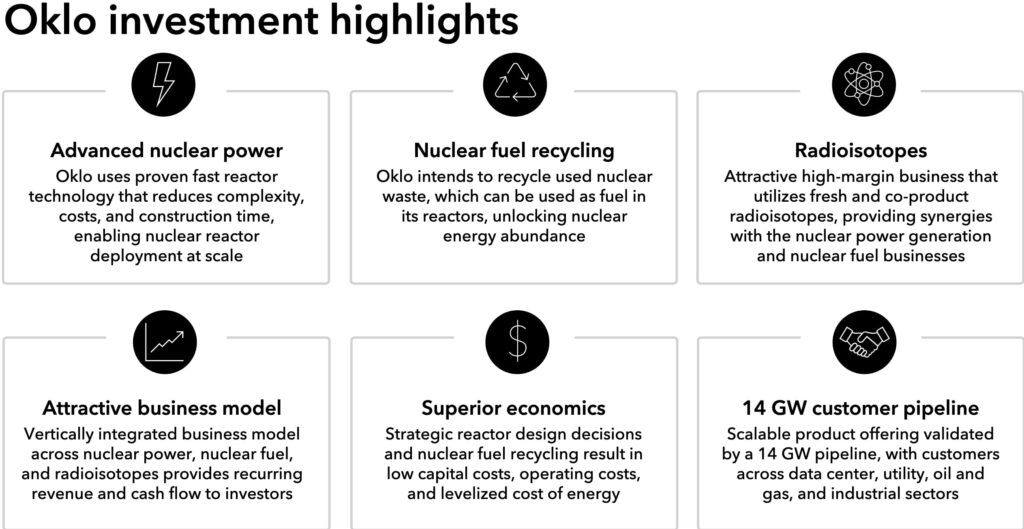
Here is their quarterly investor pitch highlights.
Oklo has signed a 20-year agreement to supply up to 12 gigawatts of nuclear power to Switch’s data centers.
Brian Wang is a Futurist Thought Leader and a popular Science blogger with 1 million readers per month. His blog Nextbigfuture.com is ranked #1 Science News Blog. It covers many disruptive technology and trends including Space, Robotics, Artificial Intelligence, Medicine, Anti-aging Biotechnology, and Nanotechnology.
Known for identifying cutting edge technologies, he is currently a Co-Founder of a startup and fundraiser for high potential early-stage companies. He is the Head of Research for Allocations for deep technology investments and an Angel Investor at Space Angels.
A frequent speaker at corporations, he has been a TEDx speaker, a Singularity University speaker and guest at numerous interviews for radio and podcasts. He is open to public speaking and advising engagements.
I guess nobody else is following this stuff? Lot of venture capital being thrown around and as usual – a lot of claims, promises, and MOUs. Carry on, I guess. MOAR musk/tesla/spaceX stories please.
There were a number of microRx platforms pitched over the preceding years by academics (e.g. SLIMM) and major industrial conglomerates (e.g. Toshiba 4S); they got no play for a number of reasons (expensive power, sodium cooling, nobody was asking for them).
The founders of Oklo have been on a multi-year campaign with the quoted intent of “creating an apple-type vibe” and were somehow able to spin an outright rejection of their initial offering by the NRC into a deal with Sam Altman. The founders are now 8-digit millionaires – mission accomplished.
Of course, others are following suit. Terrestrial Energy IPO incoming. Recent IPO by father/daughter team Deep Fission/Deep Isolation. The remarkable thing is the silence among most of the [now] old school teams we’ve been talking about for years… The ones who are perpetually going to build something next year like FLIBE, ThorCon, Moltex. The hype train is speeding down the rails and these guys aren’t on it.
NuScale market cap is at least 3x higher than the projected cost for 12-unit station and still no customers, while GE decides to do what they always could: pitches a 300MWe BWR within the last 24 months and has OPG as first customer. Is market cap even liquid/useful to accomplish the goal of construction? Seems like it isn’t.
Interesting times. Likely a step backwards for nuclear that will chill future investment. Ignorance abounds. My coworker asked me why X-AI doesn’t just design/build its own large gas turbines if they can’t get them from GE due to the waiting list. That explains the bubble – even the smart ones (engineers) wonder why upstarts don’t simply enter the natural gas turbine market, not appreciating the 60+ years of development/expertise behind GE’s 430MWe H-class turbines. There is a reason every plane you ever flew on has a GE, PW, or RR jet engine. One does not simply ‘enter that market’.