
European Procurement of US-Made Fighter Jet Wingmen, NGAD Successors, High-End Drones & Response to Starship Dominance
Europe is not going it alone on next-generation airpower. Instead, it is pursuing a pragmatic hybrid: buying cutting-edge US technology quickly while insisting on local final assembly, software sovereignty, and industrial offsets to satisfy political strategic autonomy demands.
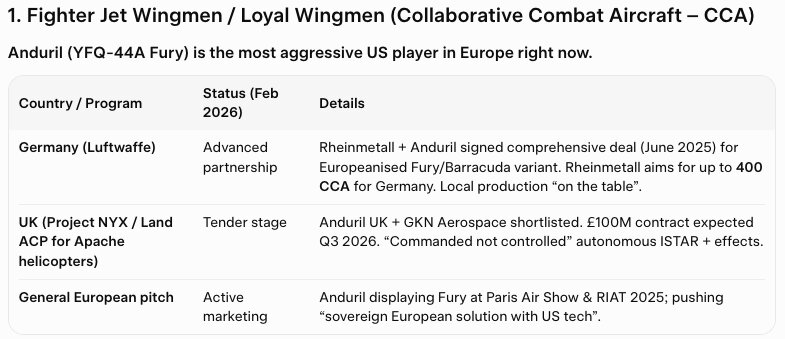
General Atomics (YFQ-42A) announced European-built variant (July 2025) with a German subsidiary doing final assembly in Oberpfaffenhofen.
Kratos (XQ-58 Valkyrie) has an Airbus partnership for European version. It is already flying with European payloads.
No country has placed firm multi-hundred orders yet. Europe wants US autonomy software + performance now but with 40–60 % local workshare. Procurement is moving fast via bilateral deals and urgent operational requirements rather than slow multinational programs.
NGAD / Next Generation Export Plane After F-35
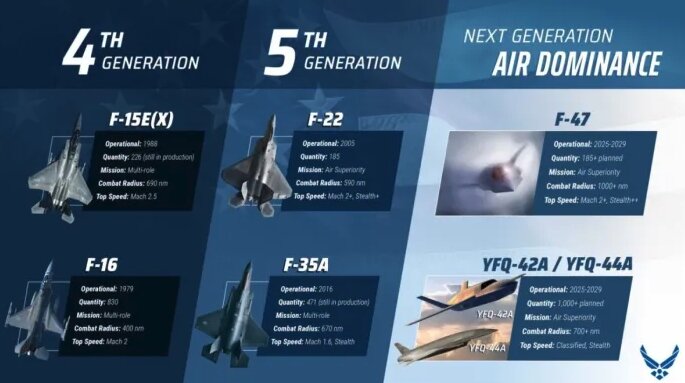
US NGAD (F-47 manned fighter) is US-only for the foreseeable future. Boeing won the manned component. First prototype flight targeted 2028. No export policy announced (similar to F-22 restrictions). The USAF is prioritizing it over additional F-35 buys. F-35 orders drop to ~18 in FY2028.
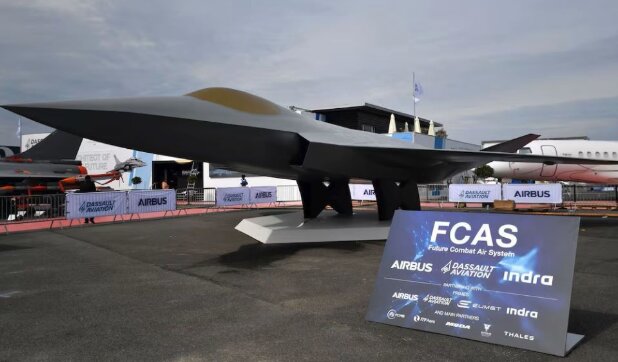
Europe’s own programs is the FCAS (Future Combat Air System with France/Germany/Spain). It is circling the drain. Germany open to more F-35s and possibly joining GCAP (UK led group). There will soon be three Europe future fighter programs (french group, german group and UK group).
Full GCAP fighter prototype (actual production-representative aircraft) is expecting first flight around 2030. This is not the 2027 tech demo. Italy/Japan are also building their own national flight-test aircraft. Actually could be four or more next generation fighters.
This was reported two days ago by Euronews.
Germany, France and Spain have been working on the Future Combat Air System (FCAS) for nearly a decade now to replace the Eurofighter and Rafale jets by 2040. The programme has been stalled due to disagreements between Airbus and Dassault. Dassault is seeking up to 80% of the NGF development and production work in France. The overall FCAS program is in deep crisis. Airbus (Germany and Spain) has publicly said it is open to a two-fighter solution. Separate French and German-led jets under a loose umbrella to keep some pretend cooperation alive.
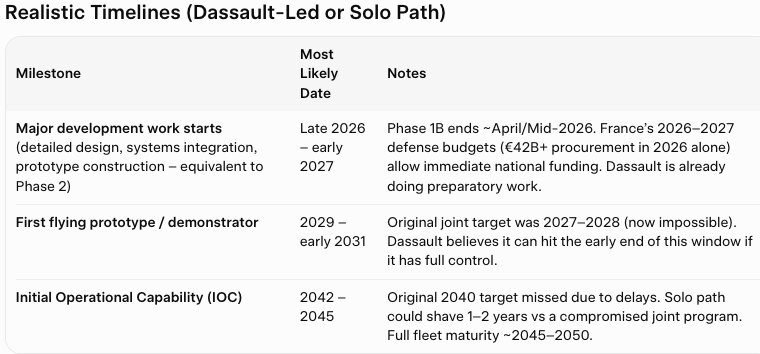
These dates assume France commits serious funding in the 2027–2030 window.
Unit Price Estimate for Dassault Future Fighter
€220–320 million flyaway cost (2026 euros) per aircraft in a French-only or French-led run of ~200–250 units.
Higher than Rafale (~€80–120M) because it is a true 6th-gen platform.
Comparable to early F-35 estimates but for much lower volume.
Hopes and Promises of True 6th Gen Fighter
This chart has some Dassault spin and BS.
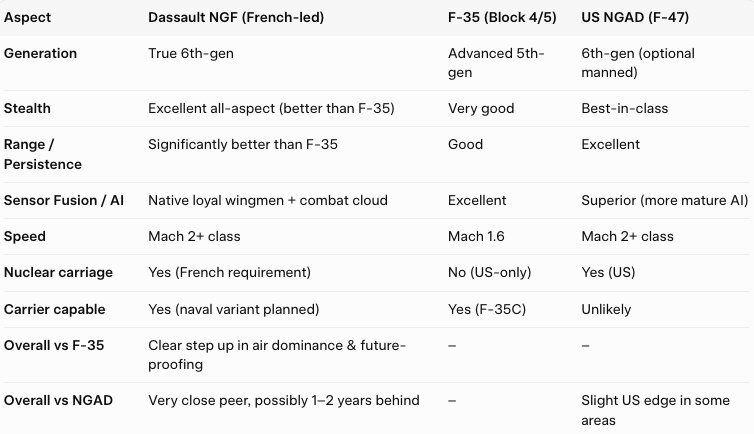
The US has been secretly flying full-scale NGAD technology demonstrators for 5+ years. These were risk-reduction vehicles (not the final F-47 configuration, but very close). This is why Boeing could start building the real F-47 prototype so quickly after winning the contract in March 2025.
Dassault has zero equivalent flying hardware for the NGF. They are still at the digital design and subsystem testing stage. Their “we can build it alone and fly in 2029” claim assumes they get immediate full funding and leadership in the next few months — which is not yet guaranteed. Dassault is making a gen 4.5 fighter with the Rafale.
Actually having a plane that can be used is targeting 2042-2045. IF there is no funding and scheduling delays. 12-20 years behind the F-47.
Dassault is talking a big game right now because the tri-national FCAS is collapsing and they want to force a French-led (or solo) path.
The US F-47 program is in a different league right now, F047 has expensive prototypes flying in secret. Dassault is still mostly on paper and PowerPoint. The PowerPoint software is also american software.
GCAP (UK/Italy/Japan) is nominally on track for 2035 service entry. We will see. All advanced weapon systems have problems. You can believe it when you see them.
The F-35 remains the only realistic high-end export fighter until ~2035+. Germany is actively considering additional F-35 tranche precisely because FCAS is delayed.
There is no US next-gen manned fighter being offered for export right now. Europe’s sixth-gen efforts are fragmented and years behind.

Brian Wang is a Futurist Thought Leader and a popular Science blogger with 1 million readers per month. His blog Nextbigfuture.com is ranked #1 Science News Blog. It covers many disruptive technology and trends including Space, Robotics, Artificial Intelligence, Medicine, Anti-aging Biotechnology, and Nanotechnology.
Known for identifying cutting edge technologies, he is currently a Co-Founder of a startup and fundraiser for high potential early-stage companies. He is the Head of Research for Allocations for deep technology investments and an Angel Investor at Space Angels.
A frequent speaker at corporations, he has been a TEDx speaker, a Singularity University speaker and guest at numerous interviews for radio and podcasts. He is open to public speaking and advising engagements.
Ukraine war drone dominance is transitional. The main weakness of drones is constantly demonstrated to be humans in the loop creating a need for constant communications. The next generation of every weapons system is robotic, entirely controlled by AI. Next generation crewed military vehicles sound like debates in the 1930’s about the design of future battleships.
Military Jets get no closer than about 50km from front lines in Ukraine. They are too vulnerable to beyond visual range SAM systems that double as ballistic missile defense (Patriot, Nasm etc) that everyone is now realising they need in vast numbers. Manpads near front line and on cheap drones add to danger. Cheap terrain following missiles and ballistics are the future. Jets are done except as bomber platforms for stand off launch of cheap glide bombs and missiles far from enemy territory.
You can’t win using hundred million dollar planes against hundred thousand dollar missiles.
Cheap Laser weapons and missile defenses (eg iron dome and iron beam) will only make it even worse.
Vast numbers of redundant cheap drones missiles and sensors are what will win non nuclear war. Until multi MW orbital laser platforms become ubiquitous due to low cost launch.
In Europe US behaviour is seen erratic at best if not openly hostile (the Greenland statements, together with the quote “I will encourage them [the russians] to do whatever the hell they want” will not be forgotten for decades). The EU is already decoupling from the american industrial complex. And your analysis conveniently forgets one aspect: the EU does not need the F35 nor the F47 because the EU projects power not through military but through economic channels. The EU is perfectly fine with a military for defense only and swedish gripens (now tested with rollsroyce engines to be completely US-independent, what a coincidence!) are perfectly suitable (and way cheaper). Furthermore Ukraine demonstrates that “air superiority” on the battlefield now is a very different thing and in many cases deploying 1 million drones costing 1000 dollars each is a better strategy than 1 billion dollar aircraft.
I think the time of US and EU strategic alliance are over. And this is squarely responsibility of US erratic leadership. The EU is beurocratic, boring and slow, but there is value in its structure: only common interest long-term plans get through all the steps. Trump unreliability managed to push ahead the decoupling plands by decades. The absurd thing is that it would have not worked so quickly had trump not pissed off canada too. Bute here we are.
Sounds like sour grapes to me.: “Our stuff can’t compete with American but we don’t need anything because we compete with economic measures. By the way, our GDP is rapidly falling behind that of America too!”
To be fair, the whole basis for the US/EU strategic alliance was that Europe couldn’t AFFORD to defend themselves after the devastation of WWII, it kind of evaporated with Europe’s economic recovery. There hasn’t been a good reason for the US and Europe to be so entangled in a long while.
I think the US will actually be much better off as just one nation among many, instead of being the security guarantor of the world. That role has been bleeding us dry and warping our domestic politics.
I think you have it backwards: The U.S. saw Europe’s and Canada’s rapid decline and decided to decouple. Europe needed a kick in the ass to wake up. (Are you really going to allow Chinese vehicle and battery companies to come in and destroy your transportation manufacturing? Why? (God help you if Volkswagen goes off the rails.) What’s next? Letting China bankrupt AirBus? Letting China, Japan, and Korea gut Europe’s communications and high-speed rail manufacturing? Rocketry? Computer chip manufacturing?)
By-the-way, American citizens are tired of sending their young men to fight Europe’s wars. And then lecturing us. The U.S. doesn’t need Russian or Middle-Eastern oil and gas. Europe does. No more American men dying for Europe’s stupidity.
Can’t believe how many American men died in WWI, WWII, Vietnam, and the Middle-East because of European failure.
The last 40 years, the U.S. made the mistake of depending on China for too much of its supply chain. America is in the middle of correcting that. I give credit to both the Biden and Trump administrations for realizing this and combatting it. America would much rather partner with Europe to get supply chains sorted out. (Europe certainly had no problems tariffing the hell out of the U.S., but now they’re indignant when the U.S. does it?)
Thankfully, Germany has finally started arming itself against Russian incursions. Kudos.
But I am nervous about European reluctance to come to grips with energy needs. And Europe’s technological prowess continues to fall behind the U.S. and China. As bad as America’s welfare programs are, Europe’s are worse.
Oh, and the only way Europe’s financial / economic might works is when it partners with the U.S. for embargos. Europe is far too dependent on Russia, The Middle East, and China. So instead, they choose to financially bully Africa, South America, the poorer nations in the Middle-East, and Israel. Then claim to be ‘superior’.
(Don’t even get me started on the ‘world’ courts in the Hague. Tries to hold everyone accountable except Western Europeans. All while Europe has the gall to rail against President Trump and the United States. Go condescend elsewhere. No wonder Europe is seen as self-centered, weak, and ineffective.)
Europe’s failures are piling up.
One disastrous decision after another.
Here’s the thing: America wants Europe to succeed. A strong Europe is good for the world and for the U.S. Europe has a larger population than America, so it should be kicking America’s butt.
It’s not.
Europe, now’s the time to take your righteous indignation and actually decide to use your remaining machining and manufacturing expertise, coupled with your university systems, and start strengthening yourselves again. Quit relying on past achievements, banking, insurance, and tourism. That’s for has-beens.
It took the U.S. too long to wake up.
Hopefully, Europe soon will.
Hopefully.
I agree that Europe needed to be woken up and that US has certainly achieved that.
One version of history is that US policy was happy to keep Europe militarily weaker to lessen the chances of another damaging European war. Germany had a small force, UK and France were bust. The Common Market was another institution designed to tie France and Germany together economically to deter conflict. Also the US stationed troops because of the Cold War. Obviously the world has changed over the decades. However Russia has become a threat again.
Europe does not need large amounts of bombers, naval forces, ICBMs etc. It does need a solid defence. It does need to be able to control the air space and the seas around it.
Some in the USA question whether the USA needs such a large military force and whether the US should concentrate on just defence. My view is that we have seen how dictatorships can gobble up small countries and grow in power till they can threaten greater countries. IMO China would become such a threat if allowed.
It is not does the USA need such a large force. It is the US Military Industrial Complex that is getting the spending and the geopolitics to happen.
What does Lockheed and Raytheon want and who are they paying off to make it happen.
Ok, since you took the time to write an extensive answer, I will try to respond to it to the best of my knowledge.
1) “The U.S. saw Europe’s and Canada’s rapid decline and decided to decouple”
Europe’s GDP is lower than that of the U.S., yes. But “rapid decline” is not an objective description. The EU produces less aggregate wealth, yet that wealth is more broadly distributed and more accessible to citizens. On most quality-of-life indicators: health outcomes, life expectancy, labor protections, social mobility, public safety… EU nations perform better than the U.S.
From a European perspective, it is quite clear that the U.S. produces more wealth, but much of it remains concentrated at the top. The frustration many Americans feel is real. However, attributing it to China, Canada, or Europe ignores the structural issue of domestic inequality.
And it is the US that shaped its own, and the global systems: From outside the U.S., it is evident that post-WWII institutions were largely shaped by American strategic and economic interests.
If U.S. GDP continues to rise while many Americans feel “ripped off,” then perhaps the issue is not foreign competition but internal wealth concentration. In that sense, yes, many Americans are indeed being squeezed, but by the billionaire class that dominates economic and political decision-making. In Europe we still maintain some structural checks against extreme wealth verticalization. That is why we sustain a higher baseline quality of life and social stability despite lower GDP.
2) “Are you really going to allow Chinese vehicle and battery companies to come in and destroy your transportation manufacturing? Why?”
For the same reason we do not feel the need to compete with Chinese coal miners.
Owning a car in Europe is not culturally central in the same way it is in the U.S. Public transport is widespread and functional. If car ownership reduces quality of life (through higher costs, congestion, longer commuting times) many people simply choose not to prioritize it.
In a global market, if China can manufacture certain goods more efficiently, the rational economic question becomes: why purchase a less efficient and therefore more expensive alternative?
Extraction jobs and heavy manufacturing are only part of economic output (and they are often lower-margin and more polluting sectors). Around 10% of U.S. GDP is tied to high tech. In the EU it is roughly 15%, This is of strategic importance. For example, Novo Nordisk, the manufacturer of Ozempic, alone contributes massively to Denmark’s GDP.
Another 5–10% of EU GDP (depending on classification) is not high tech but consists of high-quality, high-identity food and beverage products: Parmigiano Reggiano, Champagne, Nutella, and so on. These are not technologically advanced goods, but their brand identity creates high added value. You can find cheaper substitutes, but Chinese competition (like a Chinese parmesan) primarily damages the lower-tier imitations (for example an american parmesan), not the original brands.
A similar argument applies to highly recognized European fashion and luxury brands (people that buy a Ferrari, a Lois Vuitton bag or a Rolex do so because they are high quality, high status brand, they do not care about the temu versions)
What may not be clear from the U.S. perspective is that Europe has long competed with a production superpower: the United States itself. And since we were allied, European economies diversified toward smaller-scale, higher-quality, high-value goods and services. This mindset is culturally ingrained. Many Europeans would rather eat chicken that costs twice as much and consume it less frequently than purchase what is perceived, rightly or wrongly, as a lower-standard chlorinated chicken that the US administration is trying really hard to push in the EU market.
3) “What’s next? Letting China bankrupt AirBus? Letting China, Japan, and Korea gut Europe’s communications and high-speed rail manufacturing? Rocketry? Computer chip manufacturing?”
The EU absolutely has strategic interests.
Historically, some strategic sectors were used as bargaining chips in broader agreements. For example, Europe allowed its domestic computing platforms to decline during the IBM era: Olivetti is a telling case. Later, U.S. pressure and market dominance embedded Microsoft systems across European institutions. Meanwhile, Linux itself, for a long time the only existing OS alternative to Windows, was developed in Europe.
In a period when geopolitical agreements appeared stable, trading one strategic interest for another perceived advantage could seem rational. Today’s uncertainty (mainly due to Trump erratic behavior) is changing that calculation.
It is also somewhat ironic to mention Airbus, given that the U.S. has openly opposed Airbus for decades, just as it opposed Bombardier.
4) “American citizens are tired of sending their young men to fight Europe’s wars. And then lecturing us. The U.S. doesn’t need Russian or Middle-Eastern oil and gas. Europe does. No more American men dying for Europe’s stupidity. Can’t believe how many American men died in WWI, WWII, Vietnam, and the Middle-East because of European failure.”
Anyone who has studied European history, and lived in Europe after WWII, understands that the U.S. fought wars primarily in its own strategic interest. That is normal for any sovereign nation.
The U.S. did not mobilize troops out of generosity. It intervened because it did not want Europe dominated by Nazi Germany or the Soviet Union, and because it did not want to be strategically encircled in the Pacific by Japan. Europe accepted this reality, including the division of the continent into spheres of influence between the U.S. and the USSR.
The EU itself was constructed precisely to prevent further European wars and to build a geopolitical entity capable of determining its own interests. That project took 60 years.
European soldiers have also been deployed, and have died, in Iraq, Syria, Afghanistan, and elsewhere. They too were not deployed out of moral altruism but as part of strategic alliances and shared interests.
The idea that U.S. military engagement was purely benevolent while others are simply ungrateful is historically inaccurate, and, honestly, childish.
It is also worth noting that U.S. military presence in Europe has been involved in serious incidents (Cermis disaster, the unresolved controversies around Ustica-Itavia Flight 870, the Ramstein airshow disaster to mention a few) where legal accountability was denied due to broader strategic considerations.
5) “The last 40 years, the U.S. made the mistake of depending on China for too much of its supply chain.”
It was not a “mistake”: it was a deliberate strategy decided by corporate stakeholders.
By reducing production costs, companies increased profit margins without raising prices and while maintaining downward pressure on domestic wages. The constant threat of delocalization prevented salary growth. Shareholders benefited enormously from this model.
Calling it a mistake now overlooks who gained from it.
6) “Europe certainly had no problems tariffing the hell out of the U.S., but now they’re indignant when the U.S. does it?”
This is factually incorrect. The average tariff rate for U.S. goods entering the EU is around 1–2%. To be precise, the calculated average is 1.3%. This is easily verifiable.
7) “As bad as America’s welfare programs are, Europe’s are worse.”
It is unclear what metric supports this claim.
European welfare systems generally provide universal healthcare, stronger labor protections, and more substantial family benefits, while costing less! For example it is widely acknowledged that the U.S. healthcare system is 2–3 times more expensive per capita than European systems, while delivering lower coverage and shorter life expectancy.
From a cost-efficiency perspective alone, this suggests the opposite of the claim.
8) “Oh, and the only way Europe’s financial / economic might works is when it partners with the U.S. for embargos. Europe is far too dependent on Russia, The Middle East, and China. So instead, they choose to financially bully Africa, South America, the poorer nations in the Middle-East, and Israel. Then claim to be ‘superior’.”
It was not the EU that imposed the Cuban embargo or staged regime-change operations in Venezuela.
The EU is actively diversifying energy sources, including cooperation with Canada, to reduce dependence on Russian energy.
9) “(Don’t even get me started on the ‘world’ courts in the Hague. Tries to hold everyone accountable except Western Europeans. All while Europe has the gall to rail against President Trump and the United States. Go condescend elsewhere. No wonder Europe is seen as self-centered, weak, and ineffective.)”
Europe has experienced its share of dictators: Hitler, Mussolini, Franco, Salazar, the Greek junta, Tito, and others. As a result, European legal systems include constitutional safeguards designed specifically to limit authoritarian power.
Most European leaders who break domestic law are prosecuted within national courts, which is why they rarely appear in The Hague.
On your side of the Atlantic please bear in mind that firing on sinking vessels (as it happened in the whole drug smugglers boat debacle) would constitute a war crime under the Geneva Conventions AND even under U.S. military doctrine. Historically, dismissing legal restraint and unwillingness to commit war crimes as “weakness” has not ended well for those who adopt that mindset.
As a European, I can say with certainty: placing individuals willing to commit war crimes in positions of leadership is not strength. It is a recipe for long-term instability and disaster.
Europe should be outsourcing its drone stuff to the geniuses in Ukraine. They should take that part of the NGAD project on.
Wish Europe well. A strong Europe with a strong defense is good for both Europeans and The U.S. And a strong America with a strong defense is good for both Europeans and the U.S.
All of that is predicated on Europe not crumbling from within. Don’t want those weapons in the hands of people with hatred toward Western ideologies…