
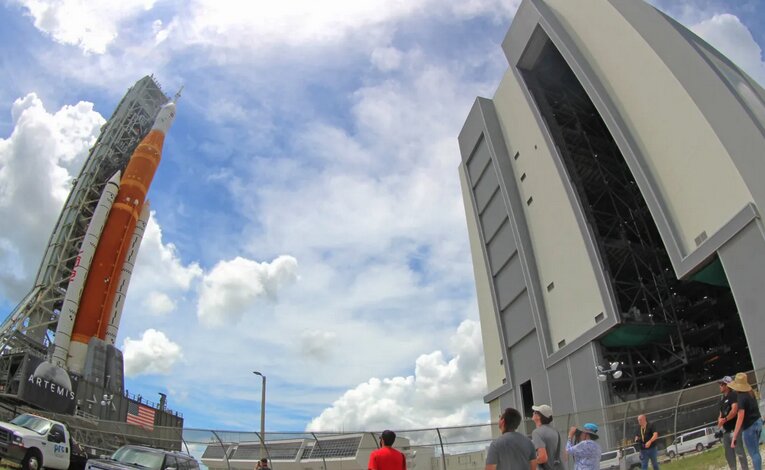
SLS still has helium leaks. Helium leaks have been a problem since the Space Shuttle days. It is so cold that it is hard to work with. The picture is of the SLS rolling back to the Vehicle Assembly Building in 2022. Rolling back to the bay for work will look the same in 2026.
– The ICPS helium bottles are used to purge the engines, as well as for LH2 and LOX tank pressurization. The systems did work correctly during WDR1 and WDR2.
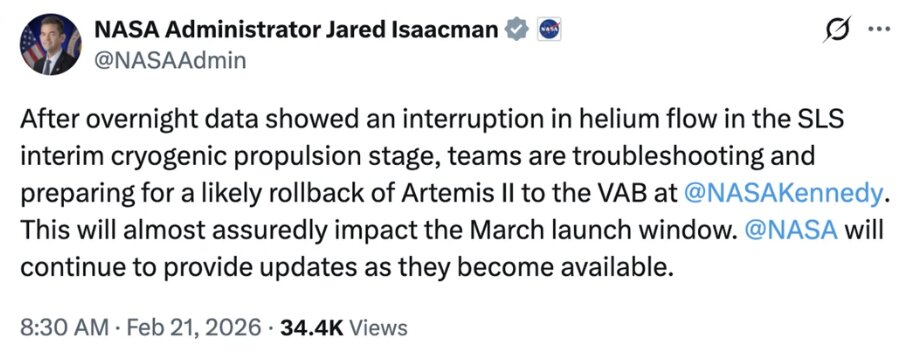
– Last evening, the team was unable to get helium flow through the vehicle. This occurred during a routine operation to repressurize the system.
– We observed a similar failure signature on Artemis I.
– The Artemis II vehicle is in a safe configuration, using ground ECS purge for the engines versus the onboard helium supply.
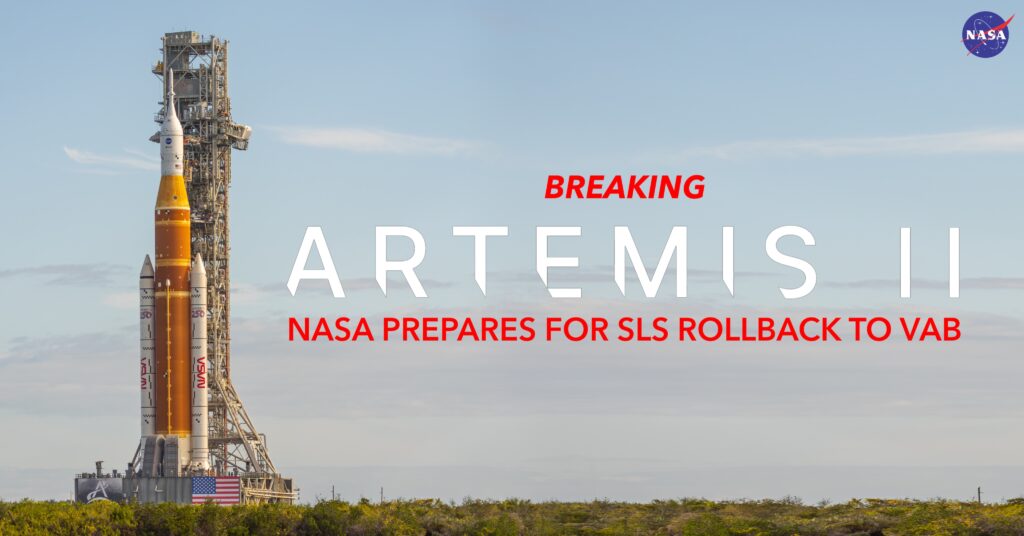
– Potential faults could include the final filter between the ground and flight vehicle, located on the umbilical, though this seems least likely based on the failure signature. It could also be a failed QD umbilical interface, where similar issues have been observed. It could also be a failed check valve onboard the vehicle, which would be consistent with Artemis I, though corrective actions were taken to minimize reoccurrence on Artemis II.
Regardless of the potential fault, accessing and remediating any of these issues can only be performed in the VAB.
Brian Wang is a Futurist Thought Leader and a popular Science blogger with 1 million readers per month. His blog Nextbigfuture.com is ranked #1 Science News Blog. It covers many disruptive technology and trends including Space, Robotics, Artificial Intelligence, Medicine, Anti-aging Biotechnology, and Nanotechnology.
Known for identifying cutting edge technologies, he is currently a Co-Founder of a startup and fundraiser for high potential early-stage companies. He is the Head of Research for Allocations for deep technology investments and an Angel Investor at Space Angels.
A frequent speaker at corporations, he has been a TEDx speaker, a Singularity University speaker and guest at numerous interviews for radio and podcasts. He is open to public speaking and advising engagements.
20th century rocket
Look on the bright side: Last time it was hydrogen leaks, now it’s helium, they’re moving up the periodic table. It should be fairly easy to keep the lithium from leaking…
Just cancel this POS already. It was DOA the second Musk unveiled his Starship plans back in 2017.
The original idea to build an expendable cargo variant of the Space Shuttle, because commercial vendors were not offering a commercial super-heavy alternative, was a good one; SLS is just a couple of decades late.
Also, NASA/Congress was late funding the cargo (a lunar lander) for it to carry.
But you’re right, NASA should make a plan to transition to commercial super-heavy rockets, instead of pretending SLS is the only solution.