
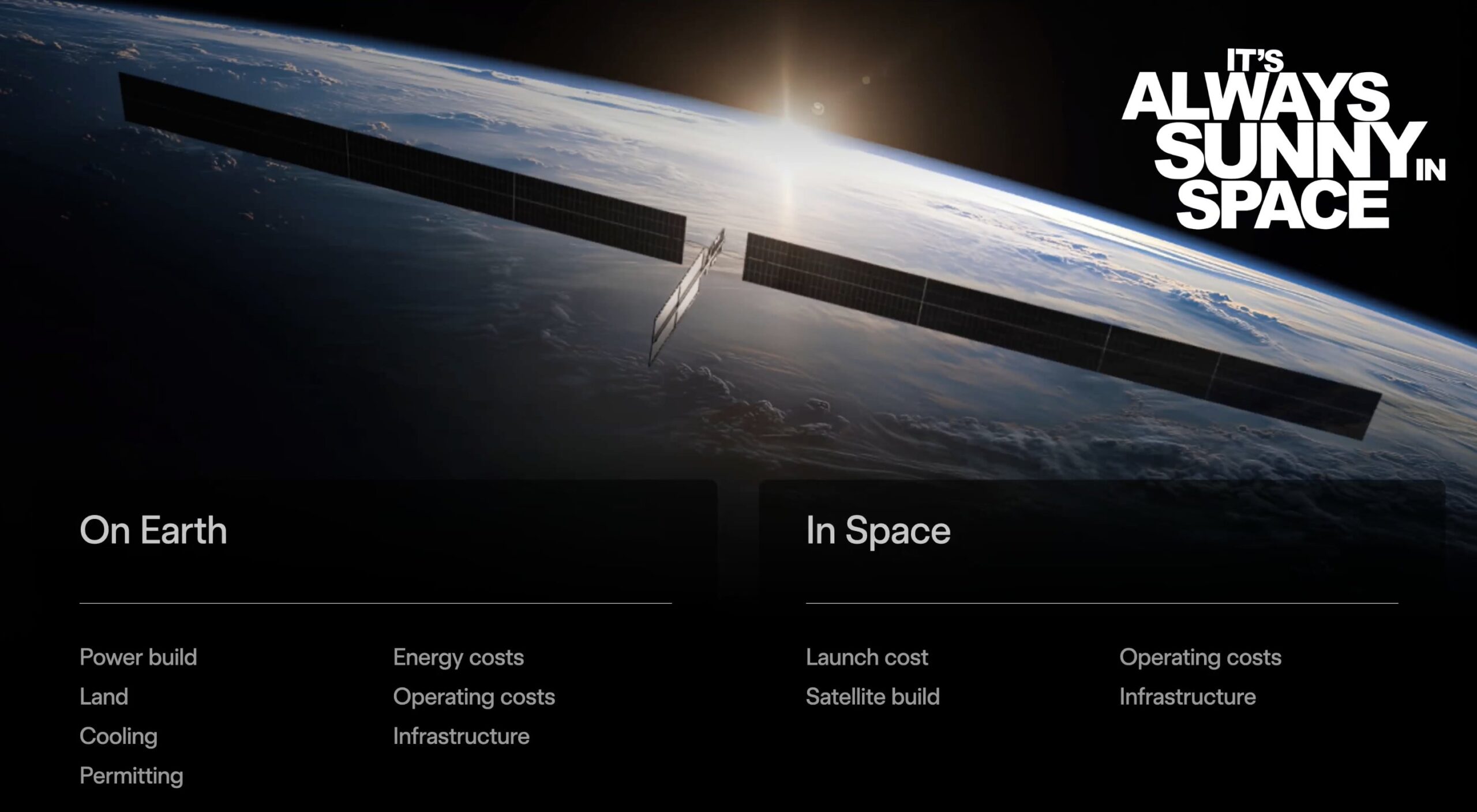
There were many complaints that radiating heat from AI Data Centers in space would be a huge problem but in fact they will be a huge advantage.
On Earth, cooling an AI data center is an active, energy-hungry process. Chillers, fans, pumps, water loops, and heat exchangers devour power simply to stop silicon from melting itself. Across the industry, cooling accounts for 30–40% of a data center’s total electricity use. Efficient hyperscalers can get that down to ~7–10% with advanced liquid cooling and PUEs near 1.1, but most facilities (especially during the current AI build-out) still sit in the 30–40% range.
For the 100 kW AI Sat Mini, the solar arrays are approximately 900 m² (roughly 6 m wide × 150 m long) and the radiators are about 100 m². The chips will run at about 100 °C. This will keep the mass and satellite cost for AI mini satellite at about 10% of the cost of the energy.
Space based cooling will be about 25-30% of the cost of the cooling on earth and equal to the best earth based locations for AI.
xAI holds permits for 41 natural gas turbines in Mississippi drawing over a gigawatt to run Colossus. A significant fraction of that gigawatt — roughly 30–40% in a typical AI cluster — does not run computation. It runs cooling. That is hundreds of megawatts burned on chillers, fans, water, and heat exchangers just to keep the chips alive.
The IEA projects global data-center electricity will double to 945 TWh by 2030 — more than Japan uses today. Transformer lead times run three years. Grid queues stretch four. Every new gigawatt of compute also needs new cooling systems. Communities on Earth are fighting new data centers. They don’t want the noise, water draw, or emissions.
In vacuum, radiation is the only cooling mechanism, and it scales with the fourth power of temperature. Raise a chip from 80 °C to 120 °C and the radiated power per square meter nearly doubles — for free, with zero extra hardware or electricity. The D3 chip being designed for Terafab’s orbital satellites will run hotter than any terrestrial processor on purpose, to exploit this physics. At 100 °C with emissivity 0.90, a single satellite can reject 100 kW of waste heat through roughly 100 m² of radiator. No water. No fans. No grid. No permits.

Brian Wang is a Futurist Thought Leader and a popular Science blogger with 1 million readers per month. His blog Nextbigfuture.com is ranked #1 Science News Blog. It covers many disruptive technology and trends including Space, Robotics, Artificial Intelligence, Medicine, Anti-aging Biotechnology, and Nanotechnology.
Known for identifying cutting edge technologies, he is currently a Co-Founder of a startup and fundraiser for high potential early-stage companies. He is the Head of Research for Allocations for deep technology investments and an Angel Investor at Space Angels.
A frequent speaker at corporations, he has been a TEDx speaker, a Singularity University speaker and guest at numerous interviews for radio and podcasts. He is open to public speaking and advising engagements.
Heat pipes can move a heat transfer fluid through the system.
Maybe a short, closed loop system to transfer the at-surface heat to the larger heat pipe system.
Gotta think thermocouple power harvesting, (seebeck effect) would be included in the system, too.
Hm… but to spread the spot heat from a few AI-chips will require pumping some kind of fluid (ammonia?) to distribute the heat into the radiators. Just conduction through a metal is not enough. And this will require a pump and an electric motor… so not just passive. Pumps and fluids take power and can brake down.
On earth, we can use gravity and the different density of gas, hot liquid, cold liquid to distribute heat passively. On space, I guess we can use centrifugal fore as gravity.
Yeah, but do you think that the satellites will rotate to produce a 1G, or similar? Thats one revolution every 5 seconds, roughly, for the 100kW satellite. Even if you rotate around the axis so that you are still pointing the solar cells towards the sun, your communication lasers – the AI satellite will be hooked into the Starlink net – will have a very difficult time staying aligned towards other satellites. And on earth, gravity assisted cooling transports liquids about 20-30 cm, whereas here you would need 10-30 meters. No, it will be ammoniak and pumps, unfortunately….
No fans, though..
I note that there is a growing level of opposition to Earth based AI data centers. They destabilize the terrestrial power grid and push up power prices for everyone, not to mention the air pollution from methane powered gas turbine generators. They rob electrical supply capacity from such vital things as air-conditioning (hot and cold) , refrigeration, and reducing vital fresh water supplies, which creates even greater health problems for consumers.
Putting these AI data centers in space is a very practical solution to this new problem.
The power used will come down as AI moves into the analogue world, however, such a high rate of progress needs to be maintained as we transition to the many profitable uses that AI will undoubtedly offer.
SpaceX has the entire package now, their impending IPO will be the biggest in human history!
This seems to ignore the basically inevitable temperature drop between the active surface of the chip, and the surface of the radiator.
That’s what all that energy spent on cooling in data centers is spent on: Moving the heat away from the chip to its eventual destination.
The fact that the chip is running at a temperature which would be good for the radiator to be operating at is really no help at all, because the radiator WILL be at a lower temperature than the chip.
I have to say that approx 900m2 / 100kw is much more than I expected. As far I know, the ISS needs around 300 – 400 m2 each 100kw, but I may be wrong. And it is worse considering possible double face radiators and GPU operating at higher temperature.
Informative.
Thank you.
Waste heat is a resource than can and should be sold.
Here in Sweden we have remote heating and cooling networks in most cities. Industrial waste heat is a primary way to inject energy into these systems.
In cold countries, heating is a major energy consumer.
If you have a lot of waste heat, you can also use it in greenhouses, store it for the winter, use it for electricity generation (https://climeon.com/heatpower-300-technology/) etc.