
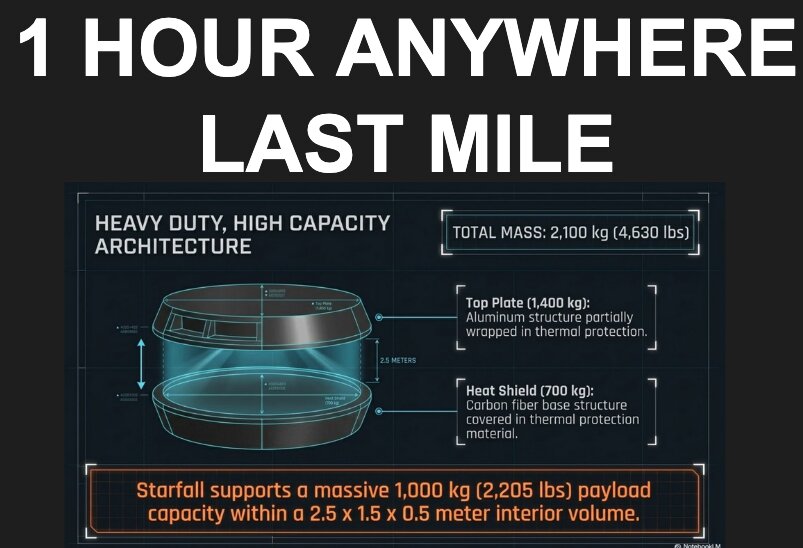
SpaceX will be proving out a key part of delivery from space or anywhere on earth in one hour anywhere. Starship flying then eject Starfalls. 50-100 per Starship. Reusable system delivers anywhere. No launch tower and no drone ship needed. Can also deliver people (military commandos first).
How much is one hour anywhere delivery at scale worth from space or point to point on Earth? Within 4-10 years, this enables millions of passenger and package deliveries before there are 200-1000 mechazilla launch towers to catch starship. Now destinations will need no infrastructure.
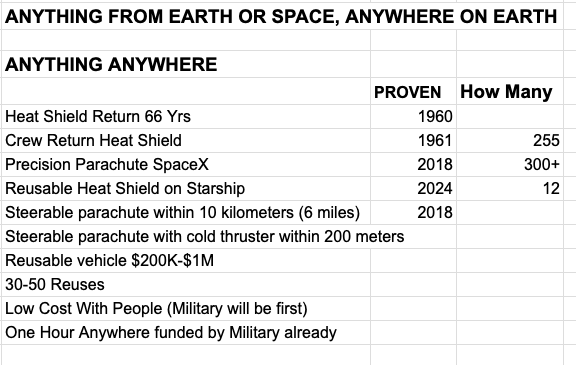
Two of the last few pieces have been proven by SpaceX.
Reusable orbital heat shield is on Starship.
Precision parachute from a space mission is the recovery of fairings.
Low cost mass manufacturing of heat shield and precision parachutes is a SpaceX speciality.
Heat shields and parachutes have been used for 65 years for cargo and people. They have been the primary method.
SpaceX will bring low cost, mass scale and new business models.
One hour anywhere the issue preventing scale was how do we get enough mechazilla launch towers to receive the goods or the drone ships for a catch or recovery.
Starfall means no infrastructure will be needed on the receiving end. Initially a ship will recover. We have used heat shield and parachutes to deliver payloads on land from orbit. Cold thrusters with parachutes can enable precision soft landings anywhere.
Cold thrusters with precision flying and landing will be proven with Tesla Roadsters.

Brian Wang is a Futurist Thought Leader and a popular Science blogger with 1 million readers per month. His blog Nextbigfuture.com is ranked #1 Science News Blog. It covers many disruptive technology and trends including Space, Robotics, Artificial Intelligence, Medicine, Anti-aging Biotechnology, and Nanotechnology.
Known for identifying cutting edge technologies, he is currently a Co-Founder of a startup and fundraiser for high potential early-stage companies. He is the Head of Research for Allocations for deep technology investments and an Angel Investor at Space Angels.
A frequent speaker at corporations, he has been a TEDx speaker, a Singularity University speaker and guest at numerous interviews for radio and podcasts. He is open to public speaking and advising engagements.
Methane is a notorious greenhouse gas. Fuel the rockets with something less harmful to the environment. I envision starfall delivering ACs everywhere to mitigate the methane leak problem they cause!
It’s definitely got military uses. In fact, that’s the obvious problem. It’s like having packages delivered by artillery, you don’t know if it’s 1 hour delivery of an Amazon order or a bunker buster until it arrives.
Skeptical take on the “Anywhere Launch” Infrastructure Model
The proposal to build a global network of ~300–400 launch towers (one every 200–500 miles) to enable 1-hour global shuttle transit is theoretically interesting but practically unfeasible. Here are the critical flaws:
Physical Reality of Launches: A rocket launch generates 180–220 dB of noise and intense heat/vibration, requiring a safety exclusion zone of several kilometers. You cannot place a launch pad “every 500 miles” near populated areas without causing massive disruption or safety hazards.
The “1-Hour Shuttle” Paradox: The text claims a 1-hour shuttle ride to the nearest tower. At 500 miles away, this requires sustained hypersonic speeds (~800+ km/h) across international borders. This ignores complex airspace sovereignty, military interception risks, and the logistical nightmare of routing civilian traffic through active military/space zones.
Economic & Regulatory Walls: Building and maintaining hundreds of heavy-lift launch sites is exponentially more expensive than traditional airports. Furthermore, the regulatory hurdles for frequent launches near population centers are likely insurmountable.
While reusable rockets are a breakthrough, this model confuses space logistics with commercial aviation. It underestimates the infrastructural and political costs while overestimating the willingness of the mass market to pay premium prices for marginal time savings (e.g., NYC to London in 2 hours vs. 7).
This reads more like sci-fi speculation than a viable near-term business plan.
Yes, I live near an airport, and it’s noisy enough. If there were a rocket launch site similarly close, my home would have to be a bunker. I believe that the noise levels will severely restrict launch locations for the foreseeable future, and it will be decades before we have the safety data necessary to get launching over populated areas approved.
So, launch sites are not going to be remotely that common.
I do see the 1 hour delivery model being popular with the military, though, as they can site launchers near military bases, and don’t care whether the people on the other end approve of the arrivals.
“How much is one hour anywhere delivery at scale worth from space or point to point on Earth? Within 4-10 years, this enables millions of passenger and package deliveries before there are 200-1000 mechazilla launch towers to catch starship. Now destinations will need no infrastructure.”
I think you are too optimistic man. Starship has lots of potential, but I dont think it will be adopted for many point – point deliveries. I see the potential market and military would definitely be interested, but technically lots of problems. But yes getting 100 tons or so in 1 h to specific drop would give military an edge.