
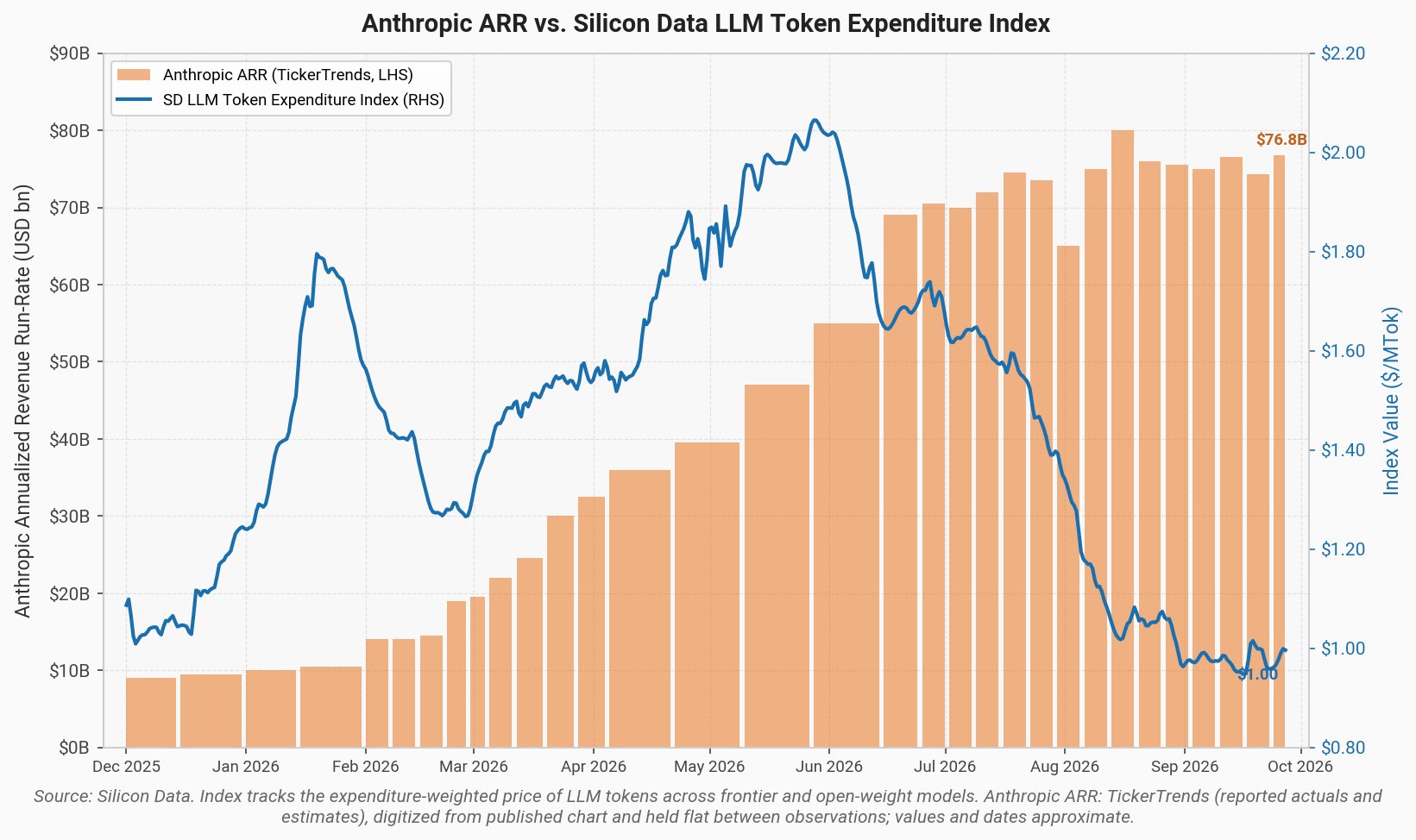
Tickerplus data indicates Anthropic’s ARR seems to have flatlined around the time when the token index peaked. Anthropic is at about $76 billion ARR.
👀 Interesting data from @tickerplus. Acc to this data, Anthropic's ARR seems to have flatlined around the time when the token index peaked. Many people questioned (rightly) at the time the inferential value of our token index for frontier labs due to the incomplete coverage. We… pic.twitter.com/DCKiArYz0j
— Silicon Data (@Silicon_Data) September 29, 2026
SpaceX was reporting $100 billion in projected ARR in Dec 2026 but seem to have added several new leasing deals that would take them to #120 Billion in ARR in Dec 2026.
There are estimates that OpenAI has about $70 billion of ARR.
OPENAI ARR NEARS $70B AS ENTERPRISE SALES MORE THAN DOUBLE – AXIOS
OpenAI’s annualized revenue run rate is approaching $70 billion, up more than 70% since the start of Q3, according to Axios.
The biggest acceleration is coming from enterprise.
Its B2B revenue has grown more… pic.twitter.com/XGkjqAXJd0
— Wall St Engine (@wallstengine) September 29, 2026

Brian Wang is a Futurist Thought Leader and a popular Science blogger with 1 million readers per month. His blog Nextbigfuture.com is ranked #1 Science News Blog. It covers many disruptive technology and trends including Space, Robotics, Artificial Intelligence, Medicine, Anti-aging Biotechnology, and Nanotechnology.
Known for identifying cutting edge technologies, he is currently a Co-Founder of a startup and fundraiser for high potential early-stage companies. He is the Head of Research for Allocations for deep technology investments and an Angel Investor at Space Angels.
A frequent speaker at corporations, he has been a TEDx speaker, a Singularity University speaker and guest at numerous interviews for radio and podcasts. He is open to public speaking and advising engagements.
Is their ARR compute constrained? The ARR above is a somewhat informed guess.
Actual financials would be helpful.
Of the AI stack – models are strangely the least profitable. The harness, the chips, the memory, and the energy are the most profitable.
There are a few things gating my 100x-10,000x increased use of AI:
1. Trust – with AI agents I can have it do a lot – but there’s 100x or 10,000x more I hold back because I don’t know what mistakes it will make. I’m also concerned about prompt injection surfaces. Also, I have to trust the harness and model provider with the context that the agent needs to do a good job.
2. Agentic capabilities – Easy for me to see giving AI 10,000x more work than I’m giving it if it could do the work and I’m already in the top 1% on AI spending.
“Of the AI stack – models are strangely the least profitable. The harness, the chips, the memory, and the energy are the most profitable. ”
The gold rush was somewhat the same; Occasional miners did well, but the real profit was to be had in supplying them, because you didn’t have to be exceptionally lucky to do well at supplying them, you just had to be competent.
The ARR shows the worst: AI is getting commoditized, at least in the non-frontier models that the vast majority and fastest growing user cohort is using, and not paying enough for. An AI professional I know uses AI at work because they pay for it, but when Claude recently started trying to charge her for AI she uses off-work, she came to me to use Grok because I get it “free” when I pay for premium X. This is going to be the trend now: 95%+ users refusing to pay anything or maybe just pay part of a bundle, like for X, or services that includes AI, while the high business case users find out AI doesn’t let them exchange labor costs through layoffs for the cost of AI, and then tries to save CapEx on AI through cheaper models. Some of these top users may be the hyperscalers themselves, like Microsoft saving on costs to run OpenAI, or even switching to cheaper Chinese or other inhouse models.
Anthropic and OpenAI are afraid to even launch an IPO now, and not because of public hostility to data centers or even costs, but because of current and future revenue collapse, which is accelerating in the now clear ARR figures.
Circular financing from Nvidea won’t be able to paper money over this loss of growth for long. The only hope the AI companies have to to engage AI in transformative change. The age of LLMs is as a growth engine is over. Now, value add has to come from somewhere else.
Cancer cures? Cold fusion? Real world robotic capability that’s truly better than humans at lower cost? All of this and much more or else lookout below in terms of stock price followed by the economy since AI is about the only thing growing at all now.
What are the prospects for the AI companies becoming profitable by exploiting Chapter 11? A lot of airlines pulled it off.
Cancer cures I could see. Medical applications in general. We’re already making great advances in that direction, and the big AI advantage isn’t being smarter than people, it’s being able to correlate more than people can thanks to having a much larger working memory. This makes it a great fit to biological research, which is about absurd amounts of detail.
Cold fusion just isn’t realistic. Fusion destroys the conditions for fusion, even if you pull it off.
Robots don’t have to be better than humans at lower cost, they just have to have a better productivity to cost ratio. As good as human at lower cost, worse than human at a lot lower cost, better than human at the same cost, all work. And if they can get the cost of a largely human equivalent robot down to the same as a car, the market for robot domestics will explode.