
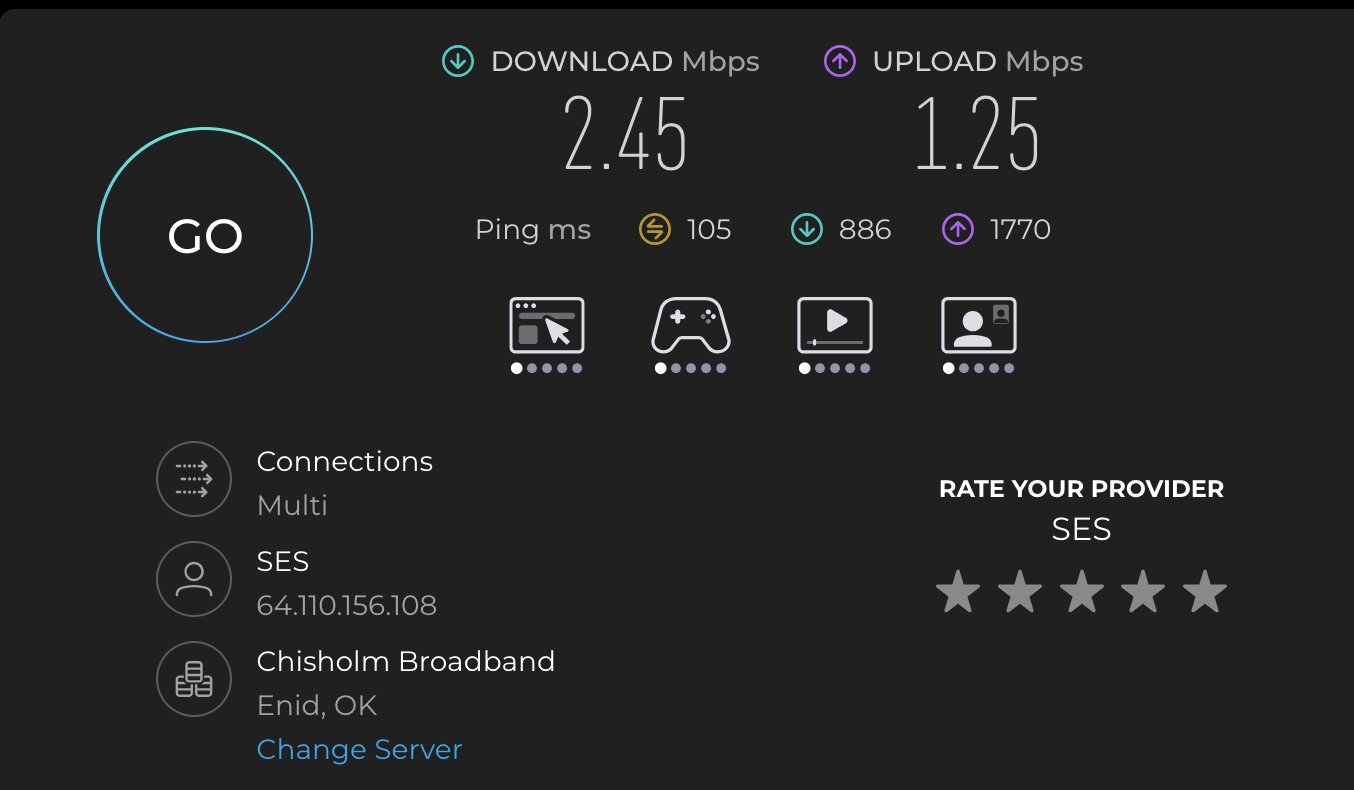
In 2026, Starlink on cruise ships is no longer a novelty. It is the default on almost every major line, and passenger reviews have settled into a consistent pattern: usable like a decent hotel connection, not like fiber at home. The old don’t even try email at sea era is gone. Congestion, price, and package tiers are the real complaints now.
1. Virgin is capping your tier, not handing you raw Starlink.
The ship’s pipe (Starlink LEO + SES MEO, plus land when docked) is shared, then shaped per plan. Premium is not whatever Starlink can do.
A tethered phone on cellular can show 4 Mbps while Premium on the same dock is 0.5–0.6 Mbps. At sea it is getting 2 to 3 mbps down and about 1.5 mbps upload.
2. Docked in a dense city is a mixed bag, not automatically worse Starlink.
Virgin’s own guides say ports often add shore/land links and can be better. What does get worse in port. Lots of people on the ship Wi‑Fi at once, antennas re-aiming, and the ship flipping between satellite and terrestrial. That can make Premium feel worse than a quiet sea day even if Starlink itself is fine over the Bay.
3. Consumer Starlink cells in SF are a separate problem.
Residential/roam Starlink in a packed metro can get congested. That is not the same capacity pool as a maritime Starlink/SES terminal with dedicated cruise service. A cruise dish is not competing 1:1 with every rooftop kit in the Mission.
Royal Caribbean actually has
Fleet-wide Starlink since 2022 on standard maritime terminals (multiple dishes, typically a cluster on the top deck — a count like ~10 nodes is normal).
Star of the Seas is the confirmed 10 Gbps ship. Other cruise chips might only have the 1 Gbps Starlink setup and plan.
Starlink said its Community Gateway there delivers 10 Gbps symmetrical ship-level throughput. SpaceX also said they put the first cruise Community Gateway on a moving ship and later showed ~8.1 Gbps “no land in sight.” Icon-class / other newbuilds may follow; it is not fleet-wide. This would mean maybe 5X more communication per passenger. But rationed however the ship wants to ration.
Norwegian
A tech worker on a 17-day Encore Panama Canal / transcontinental sailing bought the full streaming + VPN package and worked most sea days: meetings, video, work apps. Speed tests were about 30–40 Mbps down and 1–2 Mbps up, with ~90% uptime.
The top level or WORK plans can cost $60 per day. Premium mid tier plans can cost $40 per day.

Brian Wang is a Futurist Thought Leader and a popular Science blogger with 1 million readers per month. His blog Nextbigfuture.com is ranked #1 Science News Blog. It covers many disruptive technology and trends including Space, Robotics, Artificial Intelligence, Medicine, Anti-aging Biotechnology, and Nanotechnology.
Known for identifying cutting edge technologies, he is currently a Co-Founder of a startup and fundraiser for high potential early-stage companies. He is the Head of Research for Allocations for deep technology investments and an Angel Investor at Space Angels.
A frequent speaker at corporations, he has been a TEDx speaker, a Singularity University speaker and guest at numerous interviews for radio and podcasts. He is open to public speaking and advising engagements.