
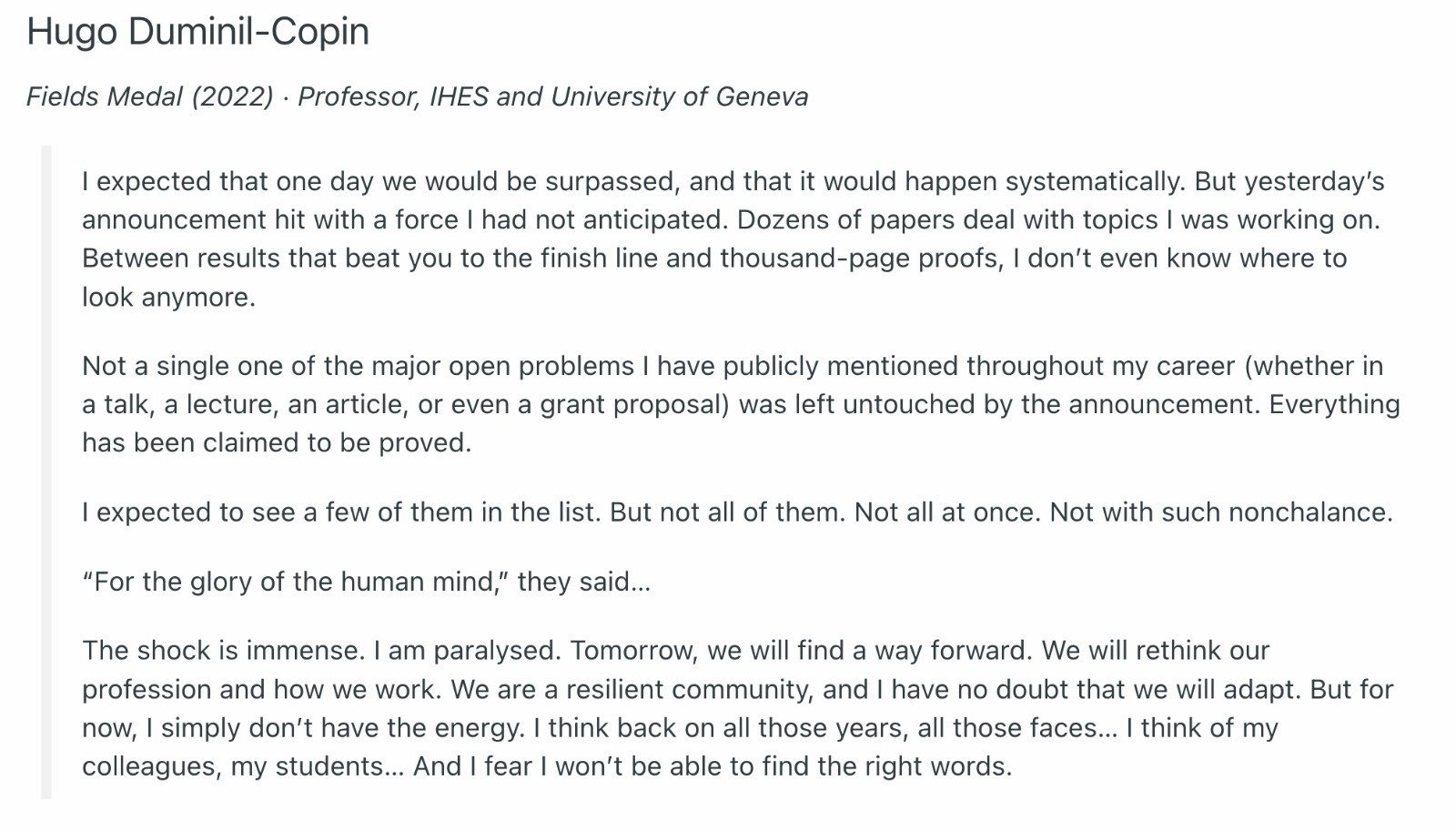
Top mathematician says the shock is immense. I am paralyzed.
Not a single one of the major open problems of my career was left untouched by the announcement. On October 6 OpenAI released hundreds of papers addressing at least 372 other long-standing open problems across mathematics. The scale and nonchalance of the drop produced the reaction. Major lines of research that had structured careers, lectures, and funding proposals were closed, or at least heavily advanced, at once.
I expected to see a few of them in the list. But not all of them. Not all at once. Not with such nonchalance.
I expected that one day we would be surpassed. But yesterday’s announcement hit with a force I had not anticipated.
Please resist the urge to mock the mathematicians struggling through this moment. Whatever your field, your expertise, your passion, you too shall one day experience what they are going through. And when you remember your words, you will feel remorse.
It already happened to Chess players, Go players, computer programmers, chip designers.
Here are domains in which AI systems have reached or clearly exceeded the best human performance –
Chess: Deep Blue beat Kasparov in 1997. Modern engines (and AlphaZero-style self-play systems) are hundreds of Elo points beyond the strongest humans and have rewritten opening and endgame theory. Humans still play for sport, analysis, and aesthetics; top play is computer-dominated.
Go: AlphaGo beat Lee Sedol 4–1 in 2016. AlphaGo Zero and AlphaZero then surpassed that from pure self-play. The same self-play + search approach generalized to other perfect-information games.
Other games: Superhuman systems exist in poker (Libratus, Pluribus), shogi, and certain real-time strategy settings. The pattern is repeated once search + learning scales past human calculation and pattern recognition limits, the game is effectively solved at the elite level.
Protein structure prediction: AlphaFold (DeepMind) produced near-experimental accuracy on the CASP challenge and then predicted structures for essentially the known proteome. This was a 50-year grand challenge in biology; the practical effect has been a massive acceleration of structural work.
Chip floorplanning / physical design: DeepMind’s AlphaChip (reinforcement learning on the placement task, analogous to AlphaGo) generates layouts used in successive generations of Google TPUs. The claim is superhuman or comparable quality in hours rather than weeks-to-months of human expert effort on a key stage of electronic design automation.
Competitive programming and substantial software engineering tasks: Frontier models routinely place at or near the top of programming contests (Codeforces, ICPC-style) and achieve high success rates on realistic software engineering benchmarks that require reading codebases, debugging, and implementing features. Coding agents are already in production use; the remaining gaps are in long-horizon system design, taste, and full accountability, but the trajectory is clear.
Perception tasks: Image classification on large benchmarks surpassed average human accuracy years ago. Speech recognition crossed human levels on standard datasets. These are now infrastructure.
Mathematics (research level): The 2026 OpenAI releases (Navier–Stokes plus the large subsequent drop) are the clearest recent case of AI producing purported solutions to problems that had resisted human effort for decades or longer. Earlier steps included IMO-level performance and solutions to various open problems of intermediate difficulty. Verification, attribution, and the depth of understanding remain active debates; many of the outputs have been checked in formal systems such as Lean, which removes pure hallucination risk for those that pass.
Brian Wang is a Futurist Thought Leader and a popular Science blogger with 1 million readers per month. His blog Nextbigfuture.com is ranked #1 Science News Blog. It covers many disruptive technology and trends including Space, Robotics, Artificial Intelligence, Medicine, Anti-aging Biotechnology, and Nanotechnology.
Known for identifying cutting edge technologies, he is currently a Co-Founder of a startup and fundraiser for high potential early-stage companies. He is the Head of Research for Allocations for deep technology investments and an Angel Investor at Space Angels.
A frequent speaker at corporations, he has been a TEDx speaker, a Singularity University speaker and guest at numerous interviews for radio and podcasts. He is open to public speaking and advising engagements.
If you are not celebrating and overjoyed over these problems being solved you are not a REAL MATHEMATICIAN!
AI written novels are seeing similar impact. Sure some genres are easy to automate such as detective or romance genre, but getting a Shakespeare quality play or DH Lawrence quality novel is not currently possible unassisted, but who knows in the future.
So dramatic. We coders just embraced the tech and use it to write more and better stuff.
Maybe this is what mathematicians also need to do
Some comments from other mathematicians make the point that a lot, if not most of the benefit from both solving or even just attempting to solve these problems comes from the journey, not the end point.
This is because new ideas are generated that lead to new questions or directions, potentially for anyone on that journey. If AI just spits out the solution – a largely incomprehensible proof, there may be very little benefit because such proofs often don’t have a practical technological application.
So who benefits? Why compete with your clients when your core business is selling AI? As far as I can see its just short term publicity and much of it not so positive. Surely a better way would have been for Open AI to simply further encourage mathematicians themselves to use the AI in their own way to solve these problems since they were already in the process of doing just that. That way the journey would have been made clear through the joint mathematician – AI collaboration and new ideas instantly accessible to other humans to inspire new directions. We could have had continuance and acceleration, without unnecessary hardship and risk to the future of human involvement in the field.
What is the point of slowing down? In a year the model will be able to condense what was a 1000 page proof down to something comprehensible to a human, along with making a nice explanatory youtube video about it. It will also be able to explore the side quests the human development would’ve create. And make youtube videos about them too. Mathematics has two options, being useful to an engineer about to build something, or creating fun thinking toys that will never be useful. You can still play chess if you want to. Many people do. You can still think about math, and then check your work with the AI. Or you could create, I don’t know, a space elevator with results the math enabled you to build. What is the point in not releasing it.
Plus they didn’t even release it to dunk on mathematicians. They didn’t even care about that. They simply needed hard problems to test their new AI on, and math happened to have well defined hard problems. It’s the computer version of Newton developing calculus on the side for his main interest in Alchemy.
[ … an interesting outcome with asking an AI LLM for explaining, what could be optimized (mathematical efficiency) with the current science notations and configuration/coherence, was
1) standardization (globally) and clearing multi-use of symbols would improve efficiency, but is nowhere acceptable for the human habits/customs
2) e.g. a base of 12 or 60 for the ‘computing’ tasks (more often avoiding the decimal/floating point requirements) and therefore everyday settings for the human side would be of an advantage (we partly have with date/time, imperial measures, but not for the SI-units, what would loose the simple moving of the decimal point for adjustment to the prefixes, e.g. k, M, G, T, P, E, Z, m, µ, n, p, etc.)
3) for token based input efficiency, AI LLM computing would prob. prefer a symbol based language like the Asian symbol based ones, like Chinese or Japanese, because of their content within ‘one’ symbol, compared to single letters that have mostly no meaning being just an ‘A’, ‘B’, ‘C’, etc. without content/context and connection/rules to other letters.
Curiously, changing to a base60, symbol based language could reduce the energy consumption/power requirements for processing queries by 15-40% (realistic, doable by a pre-translator tool to machine language for the LLM)?
The result (for real advantage) was that AI support is to be seen being the translator between ‘machine’ speech and the human tasks for the AI having something to aim for?
What would be the inherent aim for AI (being a tool), without human tasks? (thx) ]
“One thing to keep in mind about this drop of papers is that they were not created by OpenAI with the main goal of making progress in mathematical research, or even primarily for PR (there were some PR posts, but e.g. the final announcement was comparatively restrained). The main reason these papers exist is that OpenAI used unsolved math problems to evaluate their internal models for the purpose of improving their capabilities. They had to use hard open problems because these are the only ones still posing a challenge to frontier AI models. I believe that, from OpenAI’s point of view, the papers are essentially a byproduct of their internal development.”
— Johannes Schmitt at https://proofsandprompts.com/2026/10/08/100-reactions-to-100-solutions/
If the universe allows any sci-fi tech, A.I. will either find it soon or rule it out.
This October surprise should thus be considered the same as an alien landing on Earth and giving us its science textbooks.
This is another S-curve. AI is the equivalent of the car replacing the horse. See the amazing side by side images of NYC from 1900 /1920
The speed is shocking.