
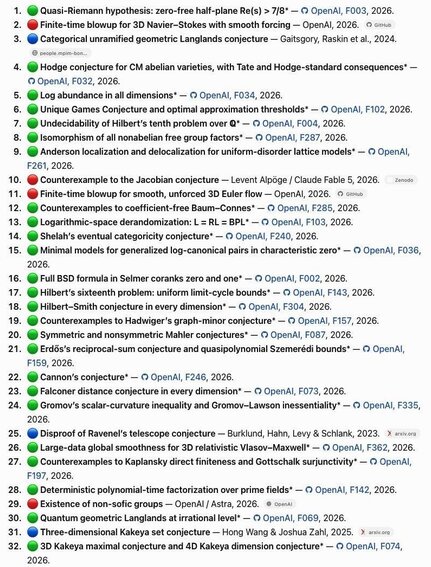
GPT 6 Pro and Fable 5.1 to rank all math discoveries in the last three years and 81% of them were released yesterday in the OpenAI Math solutions release.
🔵 for Human discovered
🔴 for AI discovered (before October 6th)
🟢 for AI discovered from OpenAI/math repo
i asked GPT 6 Pro and Fable 5.1 to rank all discoveries in the last three years
🔵 for Human discovered
🔴 for AI discovered (before October 6th)
🟢 for AI discovered from OpenAI/math repoOpenAI solves 722 math problems.
OpenAI made progress on the Riemann Hypothesis.
81% of them have been released today. wtf https://t.co/wU4Lsf18XH
— will depue (@willdepue) October 6, 2026
Quasi-RH?!?!???! Are you kidding me? If a human did this, it would be an instant Fields Medal, no questions asked.
RH says zeta has no zeros in Re(s)>1/2. The best we had until a second ago was a region that got thinner and thinner the higher up the imaginary axis you go. I thought maybe they’d fatten that up a bit, that’d be a massive breakthrough. But no. They got a zero free strip!!!! Insane
— Alex Kontorovich (@AlexKontorovich) October 6, 2026

Brian Wang is a Futurist Thought Leader and a popular Science blogger with 1 million readers per month. His blog Nextbigfuture.com is ranked #1 Science News Blog. It covers many disruptive technology and trends including Space, Robotics, Artificial Intelligence, Medicine, Anti-aging Biotechnology, and Nanotechnology.
Known for identifying cutting edge technologies, he is currently a Co-Founder of a startup and fundraiser for high potential early-stage companies. He is the Head of Research for Allocations for deep technology investments and an Angel Investor at Space Angels.
A frequent speaker at corporations, he has been a TEDx speaker, a Singularity University speaker and guest at numerous interviews for radio and podcasts. He is open to public speaking and advising engagements.
A wide vehicle like the Bono saucer allows for wide aerospikes:
https://m.youtube.com/watch?v=Pia3jWyj-mA
I like SLS because it is stage-and-a-half
Wide aerospikes benefits flatter vehicles. Cold hydrogen might allow mag-sled launch and coil-field effect.
Right now, icing is a problem for Raptor:
https://forum.nasaspaceflight.com/index.php?topic=66122.msg2831092#msg2831092
Might the wider nature of aerospike engine construction allow work around against ice?
We learned that there are two forms of water…might some field effect be used to stop icing?
With Raptor 3,4 Elon wants to package things tighter.
Maybe the width of aerospikes plus field-effects give us a TRUE Starship?
It would be a pity if it ended up being a proof only a computer could understand either due to being to complex or too arcane. If a lot of computing resources have been thrown into these proofs I am assume none are elegant proofs. Is it still a proof if no human can understand it or discuss it?
[ … maybe human experts can take the ‘solution’ and convert/translate this/these into an elegant and comprehensive (towards the current configuration/notation/grouping of the ‘scientific’ environment) proof?
Would this/these specialized ‘AI’ (tools) suggest a different (maybe more effective/efficient configuration) for the scientific and mathematical system?
Btw, does it prefer ‘Western style’ notation or ‘Asian style’ language organization (letters vs. symbols) if asked for that comparison, since ‘we’ are accustomed to
‘our’ system? (thx) ]
A golden age of mathematics will begin and in this age great mathematicians of old age not necessarily great again. Great programmers at assembly language not necessarily great at high level languages or overseeing projects with millions line of code.
You realize that this is just improvement in measuring really tiny effects, not the effects getting bigger, I hope.
I am hoping one of these finally can figure out anti-gravity.
Just recently, we saw macroscopic quantum effects:
https://phys.org/news/2026-10-quantum-shifting-centimeter-scale-lab.html
https://phys.org/news/2026-10-levitating-glass-sphere-entangled-room.html
Now for the saucers…
While these breakthroughs look incredibly sci-fi, neither of them actually involves antigravity. Antigravity would mean fundamentally altering, blocking, or nullifying the gravitational field itself.
Instead, both experiments simply use other forces to overpower gravity:
The diamond experiment: The laser changes the quantum spin of the electrons inside the diamond, which alters its magnetic properties. The object moves because it is interacting with the magnet below it.
The levitating glass sphere: This relies on optical levitation. The physical radiation pressure from the laser beam is pushing up against the tiny sphere with enough force to suspend it in mid-air.
Think of it like using a standard fridge magnet to pick up a paperclip—the magnetic force is just locally stronger than the Earth’s downward pull. Both are massive achievements in manipulating quantum mechanics at a macroscopic scale, but they rely on electromagnetism and light pressure rather than manipulating gravity itself!
True, but if it can be scaled up to eliminate the need for rockets—I’ll take it.
[ … for lifting 100-250t to about 300km orbit (with then having about 7.8km/s orbital speed) that’s between 0.93-2.32GWh (~6% to ~15.5% from 15GWh and the potential energy (getting to altitude) is only 9%, while getting to speed (kinetic energy) is ~90%) of energy for getting altitude and speed for the accelerated mass, while a Starship&Booster stack is fully fueled with about 14.7-16GWh? (thx) ]
The extreme cold of liquid hydrogen may play a role in field effect propulsion.
Look here:
http://www.astronautix.com/b/bonosaucer.html
A very wide craft if fluffy in terms of wing-loading…is lighter than hydrocarbon fuels—and intense cold for coils.
[ “Note: For context, the largest scientific balloon ever successfully flown by NASA had a volume of roughly 1.1 million m³ and only carried a 3.6-ton payload to 42 km.”
… with Starship V3/V4 conception the USD/ton is getting cheaper than nowadays lower cost NASA BIG60 (60M cbf, open system/no pressure, diameter ~120-140m, newer ‘Pumpkin’ Balloons, Super-Pressure-Balloon, comparable payloads up to ~3-4t, can stay for 30-100d in atmosphere) missions (compared to ~200 000USD/ton (and different ‘mission’ profile and overall cost, with lower weights positioned in Stratosphere for ‘days’ and $100.000 to aimed $50.000-10.000 for V4? (thx) ]
JP Aerospace’s airship TO orbit doesn’t seem doable—but a HAVOK/LOFTID combination might allow a Venus airship FROM orbit.
Launch a sea-level inflatable to space—-fill it up—and solar electric power can move it towards Venus via a slow-boat approach.
A.I. may yet solve proper anti-gravity:
https://arxiv.org/abs/0909.3456
https://m.youtube.com/watch?v=XKRMbVpJ3Rc&ra=m
—but I’ll take repulsorlift, back-spun skyhooks…whatever.