
Most people think SpaceX is a rocket company that is overvalued at $2 trillion. That view is out of date. SpaceX revenue went from $7.6 billion in Q2 to $14.6 billion in Q3, nearly double in one quarter. Elon now says a $500 billion to $1 trillion revenue run rate is coming by the end of 2027. If you own Tesla or want to own SpaceX [VERIFY $SPCX ticker], the question for 2027 is which one is the better investment.
I go through it in four steps: revenue, growth, the multiple compared against Nvidia and Apple, and then the share price I expect for each company at different dates in 2027. First, the new Tesla robotaxi numbers.
Sponsor: This post and video are sponsored by Kalshi, a prediction market where you trade on the outcomes of real events. Sign up at http://kalshi.com/r/nextbigfuture
Tesla robotaxi is ramping
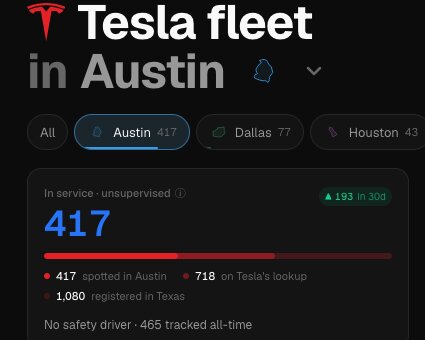
718 Tesla robotaxis in Austin now.
About +20% per week growth in the fleet.
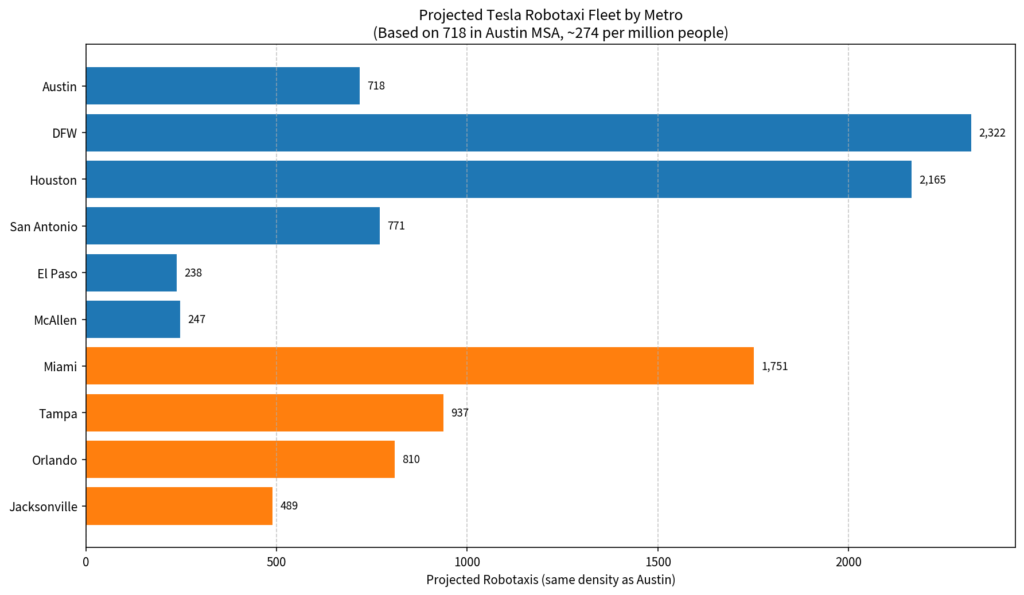
Scaling the 5 other existing robotaxi cities to Austin density gets to about 10,000 robotaxis.
FSD 15.x going wide could double or triple Tesla’s earnings.
On the last earnings call, Tesla said it is getting to real volume on pretty much everything in Q2 or Q3. It is almost at 1,000 unsupervised vehicles in Texas and Florida [VERIFY ~1,000 figure and timing vs the 718 Austin count].
Step 1: Revenue
SpaceX is building minihard AI data centers.
My estimate is that each one pays for itself in about six months. Ark Invest indicates SpaceX AI data center costs about $30-31 billion per gigawatt to build and brings in about $26-27 billion a year (deutsche Bank Research).
SpaceX has also said it will have 440,000 Rubin chips working by the end of the first half of 2027 on the Q3 earnings call. Elon has said he is utterly confident about the first ten gigawatts adding to the 3 gigawatts done at the end of 206. Land, power, chips, everything done, turned on and making money.
Why it’s fast. Jensen Huang told Brad Gerstner that the bottleneck for everyone else isn’t chips. It’s land, power and the building shell. That is exactly what SpaceX has solved.
Drone video from the RGV shows SpaceX going from dirt to a building in about a month. It is building in Texas, Mississippi and Tennessee, maybe in other locations too, and it is mass-producing these data centers. SpaceX will provide the land, power, shell and cooling, everything except the chips.
Step 2: Growth>
The quarters go from $7.6 billion to $14.6 billion. I think the next quarter is around $30 billion.
SpaceX guided $33-37 billion for Q1 2027. This is sandbagging. I think they come in at $40-50 billion for Q1 2027.
After that, about $70 billion in Q2, and then Q3 nearly doubles again. By the end of 2027 that is a run rate of $50 billion a month, which is about $600 billion a year. That fits inside Elon’s $500 billion to $1 trillion range.
Adding up the months gives about $300 billion of 2027 revenue at very high margins. That would be $150-200 billion of profit [VERIFY margin; the original recording said “7%”]. That is my model.
Step 3: The multiple vs Nvidia and Apple
$150 billion of profit puts SpaceX in Nvidia and Apple territory. Those companies are in the $150-200 billion annual profit range, and SpaceX would be growing much faster: 300%, 400%, 500% a year.
That is the vertical growth phase, and it means a very favorable PE-to-growth ratio. If SpaceX hits a $1 trillion revenue run rate, it is comparable to Nvidia. The top three to five companies are worth $4-5 trillion each, and SpaceX gets into that zone.
Step 4: The share price
This is my forecast.
January 2027: I expect new earnings around January 20th of maybe $25-30 billion of revenue and close to $10 billion of profit, plus Starship catches and reflights. That puts SpaceX at about $200-250 a share, only $2.5-3 trillion. Tesla is near all-time highs of about $500, roughly a $2 trillion company. One is worth about $3 trillion, the other about $2 trillion, so the merger math still works.
April 2027: SpaceX reports Q1. If it comes in at $40-50 billion of revenue, the story gets confirmed. There could be a pause if data centers are completed but waiting for Rubin chips. Rubin is about three times better than GB300, so it can make sense to give up two or three months of revenue to fill the shells with Rubin.
July 2027: On the Q2 earnings call, if SpaceX is doing $70-100 billion of quarterly revenue and about $50 billion of profit, the market bends the knee. SpaceX is worth about $500 a share, around $6 trillion
Tesla on that timeline is still at $2-2.5 trillion unless it executes on massive Robotaxi scaling and Teslabot. If Tesla shows it is ramping factory production and using a Optimus at scale in factories and robotaxi scales, I think it can be above $600-800 and keep pace. If Tesla kicks the can down the road again and only has improved FSD revenue, the shares may sit at only $450-500.
Tesla
I’ve held Tesla for years. Like everyone else, I’m frustrated by the extra five years of waiting.
Here is what moves the stock in 2027. Tesla has to show that robotaxi and Optimus are scaling: more vehicles, more cities, factory production increasing, and the savings showing up in the balance sheet. The robotaxi ramp above is the path. 718 in Austin and growing 20% a week is how you get toward 10,000 vehicles. FSD 15.x going wide is what could double or triple earnings.
Tesla needs to execute in Q2 to match a $4-5 trillion SpaceX.
My 2027 call
SpaceX has more upside in 2027. I am very confident SpaceX does a 3X to 5X next year. I am pretty confident Tesla, even without a merger, can do a 2X, maybe 3X from here. The longer-term potential is a 10x by mid-2028.
Tesla is the hedge if the SpaceX-Tesla merger is delayed. If you are worried about the merger not happening or getting delayed, build a position in SpaceX. Or you can say the merger will happen and accept that you may fall behind a bit.
I have about equal levels of both. I’m not selling Tesla to get in, because I’m already covered. Depending on your tax situation, selling to switch may not make sense. Size your own taxes and risk.
Disclaimer: Nothing in this article or video is financial, investment or trading advice. Forecasts, models and robotaxi fleet, revenue, valuation or timing projections are the opinions and estimates of Brian Wang. They are not company guidance and may be wrong. Do your own research. Prediction-market trading involves risk of loss.
Disclosure: Sponsored by Kalshi. Brian Wang is paid by Kalshi when readers sign up through his link, and new users will receive a $50 sign-up bonus.

Brian Wang is a Futurist Thought Leader and a popular Science blogger with 1 million readers per month. His blog Nextbigfuture.com is ranked #1 Science News Blog. It covers many disruptive technology and trends including Space, Robotics, Artificial Intelligence, Medicine, Anti-aging Biotechnology, and Nanotechnology.
Known for identifying cutting edge technologies, he is currently a Co-Founder of a startup and fundraiser for high potential early-stage companies. He is the Head of Research for Allocations for deep technology investments and an Angel Investor at Space Angels.
A frequent speaker at corporations, he has been a TEDx speaker, a Singularity University speaker and guest at numerous interviews for radio and podcasts. He is open to public speaking and advising engagements.
Here is an alternative &, dare I say, more balanced perspective?
My overall ranking
1. SpaceX: Greater potential growth and upside
2. Tesla: More established underlying operating business
Joe’s vs Brian’s predictions:
SpaceX reaches $300B 2027 revenue:
Brian: Expected VS Joe: Low probability
SpaceX reaches $4–6T valuation
Brian: Bullish expectation VS Joe: Possible, not base case
SpaceX delivers 3–5x
Brian: Very confident VS Joe: Approximately 10% probability of 2.5x+
Tesla delivers 2–3x
Brian: Pretty confident VS Joe: Approximately 15–20% probability of 2x
Tesla robotaxis scale substantially
Brian: Yes VS Joe: More likely than not
Optimus becomes a major earnings contributor in 2027
Brian: Bullish VS Joe: Less likely than not
What I would watch before making the investment decision.
There are 3 particularly important quarterly tests:
• SpaceX: Is actual AI computing revenue growing at the rate required to justify its infrastructure investment?
• SpaceX: Are operating cash flow and margins improving, rather than simply revenue and installed capacity?
• Tesla: Are robotaxi miles, paying customers and revenue per vehicle growing together?
Consider these 3 measures more than CEO’s projections or analyst price targets.
Should You Buy $TSLA or $SPCX for 2027?
. YES!!!