
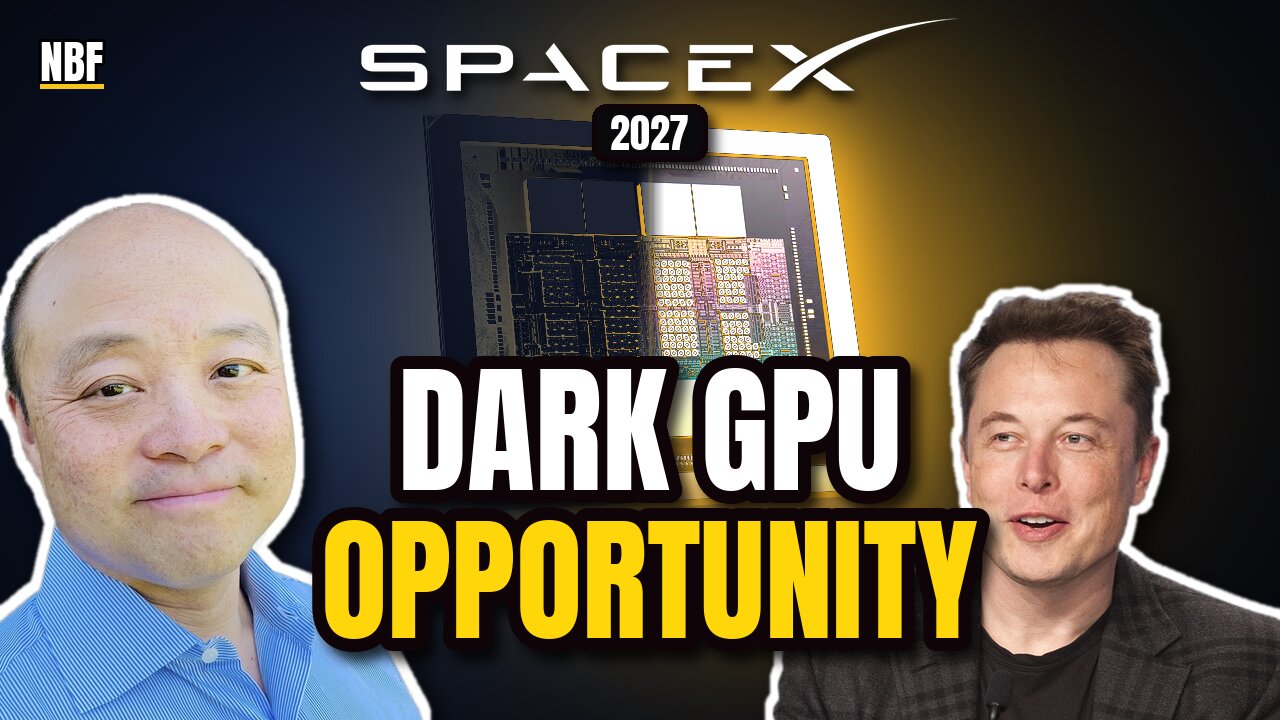
The common view is that stranded AI chips are a write-off, money spent too early. The chips are fine. What’s missing is power. And one company has solved power faster than anyone else.
The dark GPU problem
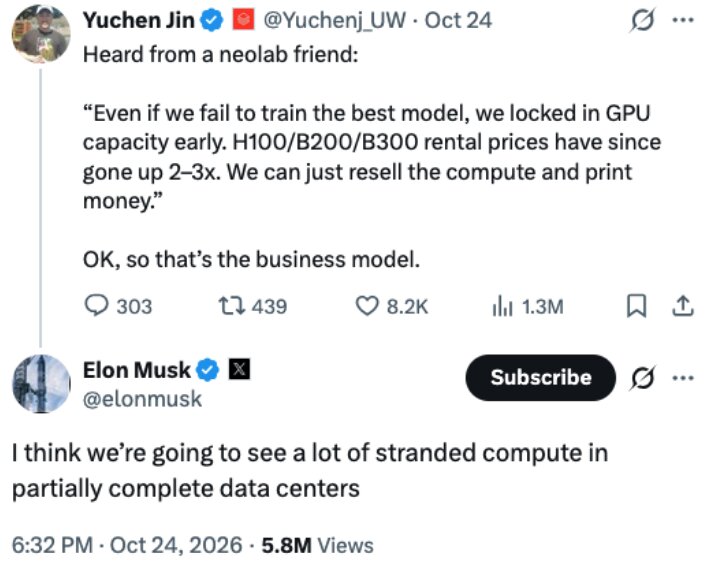
Elon Musk has said there could be up to 15 GW of stranded compute sitting in partially completed data centers. A partially completed data center cannot serve compute. It needs power, cooling and everything else in place before it can earn a dollar.
This is the AI-era version of dark fiber. During the internet boom, fiber was laid that could not be used. Now there are GPUs and memory, already bought and often sitting in warehouses, that cannot be plugged in.
How big is it? Jensen Huang said that out of a $50–60 billion gigawatt AI factory. Multiply 15 GW by about $35B/GW and you get roughly $525 billion of NVIDIA content. My working figure for dark chips is about $300 billion and growing.
Why the shortage happens
Hyperscalers order the GPUs, build the powered shell, then wait for the power and the missing parts. Then they can finally fully activate. In the meantime, the GPUs are dark.
The power gap is large and well documented. Morgan Stanley’s September 21, 2026 model has the US needing about 97 GW for data centers in 2026–28. Subtract projects under construction and available grid capacity and that leaves a 57 GW gross gap. After probability-weighted behind-the-meter gas turbines and engines, fuel cells and nuclear co-location, the net shortfall is still ~33 GW. Its October 5 note puts it at 32 GW, about 34% of demand. For 2027 alone, the analyst consensus cited by Elon is at least a 15 GW shortfall for AI chips.
So the GPU gap (~15 GW of dark chips) matches the power gap (≥15 GW in 2027).
SpaceX solves the power problem
SpaceX expects about 3 GW of AI compute at the end of 2026 and plans to add 20 GW in 2027, for 23 GW. Elon says he is confident of 13 GW. The range from 13 to 23 GW depends on how many GPUs and how much memory SpaceX can get allocated.
SpaceX builds its standardized Minihard data centers in about 5 months, compared with about 22 months for a typical build. It is building faster than it can get chips. That means SpaceX could have extra, fully powered buildings with no chips of its own until 2028. By my estimate, others hold ~15 GW of dark chips against 8–10 GW of extra SpaceX shell.
The shells are cheap. A draft SpaceX S-1, as reported by [PitchBook](https://pitchbook.com/news/articles/spacex-s1-deleted-disclosure-ai-infrastructure), put SpaceX’s powered shell at about $2.7B per GW vs an industry benchmark of about $12B per GW. It says only that costs are “considerably lower than industry benchmarks on a per megawatt basis.”
How the deal will work
SpaceX already charges about $50–60 billion per GW when it supplies everything, chips included. In the new case, the customer brings its own GPUs, CPUs and memory, which are $25–30 billion of a $50 billion build, and SpaceX gives a hardware credit for them. That still leaves SpaceX roughly $37 billion per GW on a building that costs it under $10 billion (MODEL).
There would then be two kinds of SpaceX leasing.
– Full: SpaceX supplies the chips and memory, as in the Anthropic and Google deals.
– Shortage leasing (Bring your own chips): the customer moves its own chips into a SpaceX shell while the shortage lasts, then moves out when its own power arrives.
Market share and the payoff
Market share depends on power delivery. SemiAnalysis projects that only about 35 GW of 2027 capacity additions will be built in the United States. If SpaceX builds 20 of those 35 GW, that is about 60% of the US market . Across 2027–28, leasing extra shells could bring SpaceX about $900 billion: 30 GW × ~$30B per GW.
SpaceX fills the AI power gap: +20 GW in 2027, from 3 GW to 23 GW. The others’ edge returns only when they solve fast construction and power.
What to watch
– Whether hyperscaler power delays persist through 2027–28, and whether Morgan Stanley’s ~32–33 GW net gap narrows.
– SpaceX’s actual build rate against the 3 GW → 23 GW plan.
– First announced “bring your own chips” leases at SpaceX sites.
*Disclaimer: Nothing here is financial, investment or trading advice. Forecasts, models and price or capacity projections are the opinions and estimates of Brian Wang. They are not company guidance and may be wrong. Do your own research. Prediction-market trading involves risk of loss.*
*Disclosure: The video is sponsored by Kalshi. Brian Wang is paid by Kalshi when viewers sign up through his link (http://kalshi.com/r/nextbigfuture. New users get a $50 sign-up bonus after depositing and spending $25

Brian Wang is a Futurist Thought Leader and a popular Science blogger with 1 million readers per month. His blog Nextbigfuture.com is ranked #1 Science News Blog. It covers many disruptive technology and trends including Space, Robotics, Artificial Intelligence, Medicine, Anti-aging Biotechnology, and Nanotechnology.
Known for identifying cutting edge technologies, he is currently a Co-Founder of a startup and fundraiser for high potential early-stage companies. He is the Head of Research for Allocations for deep technology investments and an Angel Investor at Space Angels.
A frequent speaker at corporations, he has been a TEDx speaker, a Singularity University speaker and guest at numerous interviews for radio and podcasts. He is open to public speaking and advising engagements.
Have you seen Semi Analysis’ recent report saying power is solved? Would love your thoughts on that.
I can’t find that anywhere. What is your source?
From Dylan Patel, head of semianalysis recent comments (CASPA panel / related discussion):
“Power is definitely a big constraint, but one thing that our research sort of shows that I think is counterintuitive to much of the market is that next year there are data center constraints but a lot less than people realize because there are nearly 50GW data centers being built globally. 7-8GW in China, 35GW in the US, and a bunch everywhere else — Australia, India, Malaysia.”
He went on to say power remains a real bottleneck, but people are working around it with onsite turbines, reciprocating engines, and fuel cells. In his view, constraints like substrates, memory, and optics (lasers etc.) are harder to patch around than power. They are still indicating most construction times are 2 years, only about 20% are so might be less than 2 years. Local grid and interconnection issues still matter (e.g., Microsoft walking away from a UK site due to power delays into the 2030s). Best of the others are trying for 7-11 month construction. Is 30-40% going to take 2 years or longer? 30% of 35GW, 10.5 GW, 40% of 35GW is 14GW.
Equipment lead times (turbines, transformers, generators) and fuel supply for onsite generation remain real risks. IEA and others continue to flag shortages.
Not all sites can easily go fully behind-the-meter. Substrates, HBM/memory, lasers, or other optics supply-chain issues, because creative onsite solutions are scaling.