
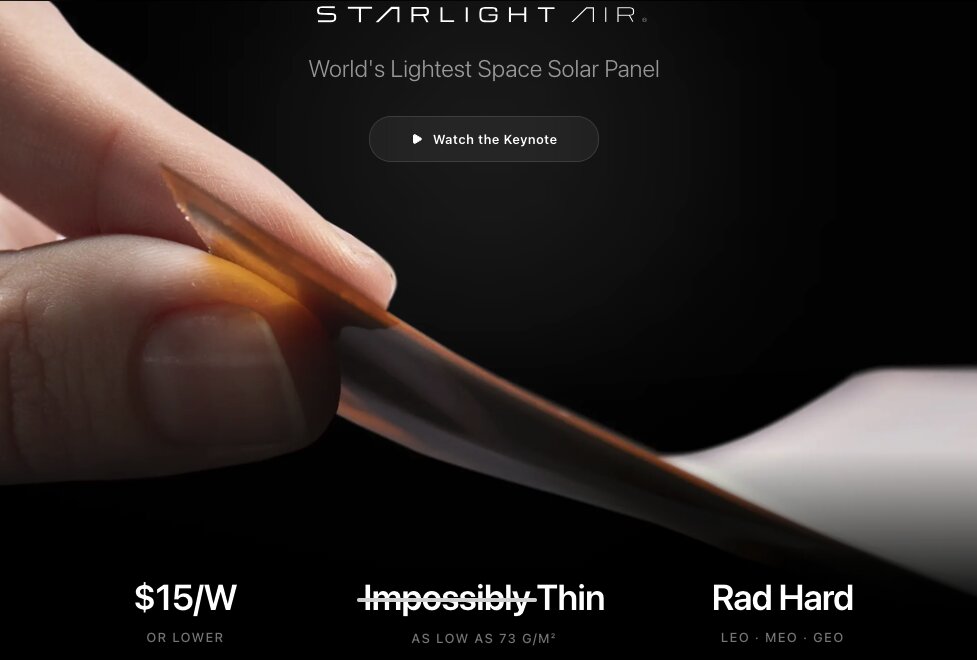
Customers are asking for 1500X scale of the 50MW first factory, 1.2 GW next factory. 2028-2030 capacity demand about 75GW. OLED converted to OLAD (Organic light absorbing material.) 50 times cheaper than old solar panels.
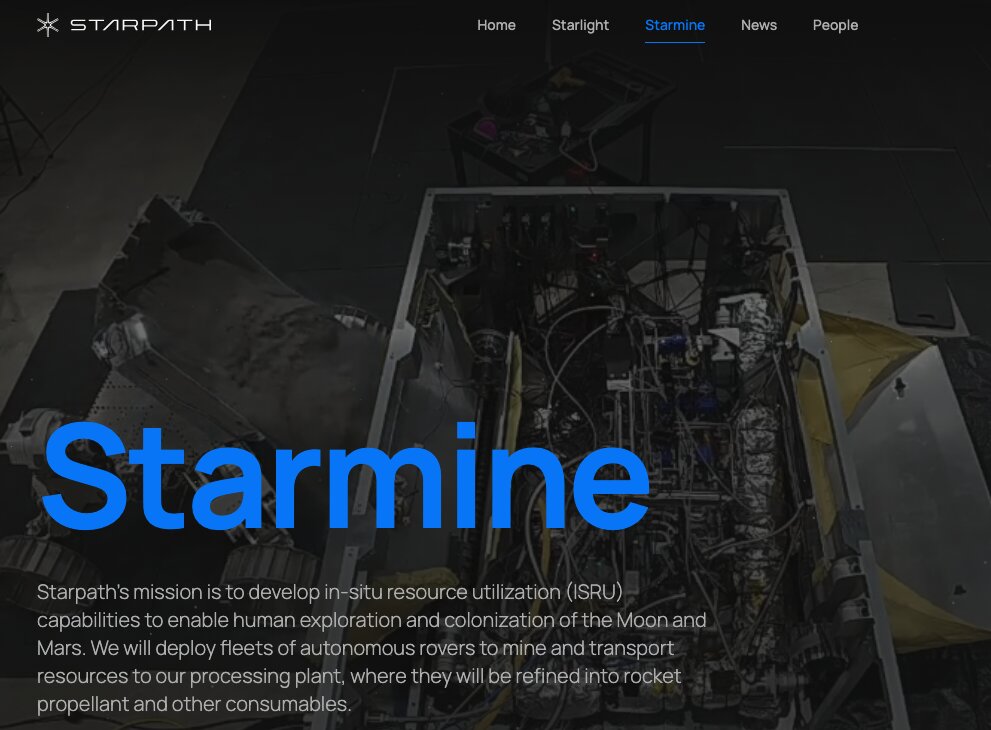
Starpath Robotics has raised a total of $14.5 million in venture capital funding. This includes a $2.5 million pre-seed round in 2023 followed by a prominent $12 million Seed round in August 2024.
The Seed round was co-led by 8VC and Fusion Fund, with participation from Day One Ventures, Balerion Space Ventures, Indicator Ventures, Hummingbird Ventures, and Valhalla. Additionally, Starpath secured an $800,000 grant from NASA after winning second place in the agency’s Break the Ice Lunar Challenge.
Starpath originally launched to develop lunar ice-mining and fuel-refining infrastructure to produce off-world rocket propellant. However, because commercial space-qualified solar panels were too expensive and under-produced for their massive power needs, they pivoted to design their own mass-producible space solar line called “Starlight”.
Starpath Space launched a new line of space solar panels today—called Starlight Air—which claim to be far lighter than anything else on the market.
The panels are just 73g per square meter, and are priced around $15 per watt.
“Starlight Air enables satellite designs that are virtually unbounded by the constraints of power,” Starpath CEO Saurav Shroff told Payload. “The approach behind designing it was: Let’s design right up against the limit of physics, so that we know that the product we’ve made is definitely the best possible product,”
Splitting hairs: Starlight Air uses a photovoltaic crystalline structure that is measured in the “hundreds of nanometers,” according to Shroff. The solar cell is printed onto a substrate fabric to increase its handleability.

Brian Wang is a Futurist Thought Leader and a popular Science blogger with 1 million readers per month. His blog Nextbigfuture.com is ranked #1 Science News Blog. It covers many disruptive technology and trends including Space, Robotics, Artificial Intelligence, Medicine, Anti-aging Biotechnology, and Nanotechnology.
Known for identifying cutting edge technologies, he is currently a Co-Founder of a startup and fundraiser for high potential early-stage companies. He is the Head of Research for Allocations for deep technology investments and an Angel Investor at Space Angels.
A frequent speaker at corporations, he has been a TEDx speaker, a Singularity University speaker and guest at numerous interviews for radio and podcasts. He is open to public speaking and advising engagements.
I am taken with the approach of big iron in having the payload and upper stage the same structure (think HEXAGON).
If I had to guess, after watching the entire clip, Starpath’s Starlight solar panels are primarily being set up as a demonstration to be acquired by SpaceX.
The clues? Demo pilot in California, main manufacturing in Austin. Lack of launch capacity of any competitor to SpaceX. Sleeping on the factory floor until production problems are solved. All designed to appeal to a certain Trillionaire’s sensibilities…
Fully agree
Starpath has a lot of fundraising and execution to get to a meaningful level. SpaceX is building its own solar at 100 GW per year, up from 50-500MW per year. They were at 50 MW per year for 3500 Starlink satellites per year.
SpaceX already expanded to 600MW-1GW factory capacity to support Version 3 satellite production. They are using regular silicon solar cell technology. Lowest cost. Vertically integrated. SpaceX cost is low because the complete satellites other than for AI chips but all solar, body etc… is in the $250K to $1 million each ranges.
I doubt Starpath will get execution or technology that will interest SpaceX. Getting bought by one of the other hyperscalers … maybe.