
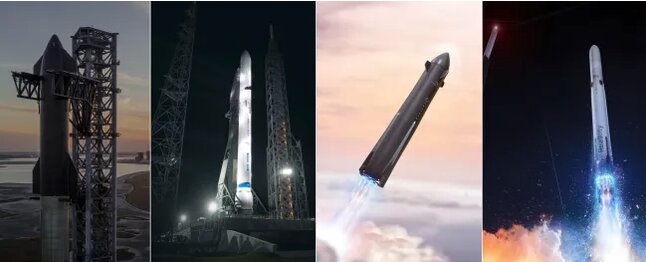
SpaceX Falcon 9 is roughly 15–18 t to LEO in reusable mode and ~23 t expendable, with boosters routinely flying 20+ times and the fleet doing dozens of launches per year. Falcon 9 has had 160-170 launches per year in 2025 and likely in 2026. This is about 2500-3000 tons per year. No other rocket or launch provider has over 100 tons to orbit in a year other than China Long March family.
SpaceX Super Heavy Starship has deployed over 50 tons to orbit. SpaceX Starship looks like it will be scaling to 100 to 120 tons per launch every month. IF SpaceX gets to three launches per month with Starship V3 they will surpass Falcon 9 in payload to orbit.
Blue Origin New Glenn is rated around 45 t to LEO with a reusable first stage. It flew in 2025, recovered a booster in November 2025, and reused that booster in April 2026. A May 2026 pad hot-fire anomaly destroyed the transporter-erector and grounded the vehicle. Blue Origin is rebuilding Launch Complex 36 and still targeting a return to flight by the end of 2026. Flight count so far is only a handful. They have discussed a larger “9×4” variant eventually aiming at very high rates (they have mentioned a long-term goal north of 100 launches/year), but no near-term schedule for that rate exists.
Relativity Terran R will put ~23.5 t to LEO with downrange booster landing and reuse and ~33.5 t expendable. Hardware is in integrated build (flight engines installed on the thrust structure, stage testing underway). The Relativity Space target has been late 2026 from Cape Canaveral LC-16. Outside observers widely expect a slip into 2027.
Rocket Lab Neutron targets 13 t to LEO reusable (downrange landing), ~8.5 t return-to-launch-site, 15 t expendable. First-stage reuse with the Hungry Hippo captive fairing. Pad delivery at Wallops is still aimed at Q4 2026. Rocket Labs has said the window for an actual 2026 launch is narrowing and a 2027 debut is increasingly likely. They have described an initial cadence of roughly one flight in year one, three in year two, and five in year three.
Firefly/Northrop Eclipse targets ~16.3 t to LEO. First stage designed for later reuse (return-to-launch-site planned after early expendable flights). First flight no earlier than 2027.
Stoke Space Nova Pathfinder (~3 t class, fully reusable both stages) targeted for early 2027, with multiple flights planned in 2027–2028. Nova Block 2 (15 t to LEO fully reusable, both stages) targeted for 2029. That is the most ambitious reuse architecture among the group, but it is still pre-flight.

Brian Wang is a Futurist Thought Leader and a popular Science blogger with 1 million readers per month. His blog Nextbigfuture.com is ranked #1 Science News Blog. It covers many disruptive technology and trends including Space, Robotics, Artificial Intelligence, Medicine, Anti-aging Biotechnology, and Nanotechnology.
Known for identifying cutting edge technologies, he is currently a Co-Founder of a startup and fundraiser for high potential early-stage companies. He is the Head of Research for Allocations for deep technology investments and an Angel Investor at Space Angels.
A frequent speaker at corporations, he has been a TEDx speaker, a Singularity University speaker and guest at numerous interviews for radio and podcasts. He is open to public speaking and advising engagements.