
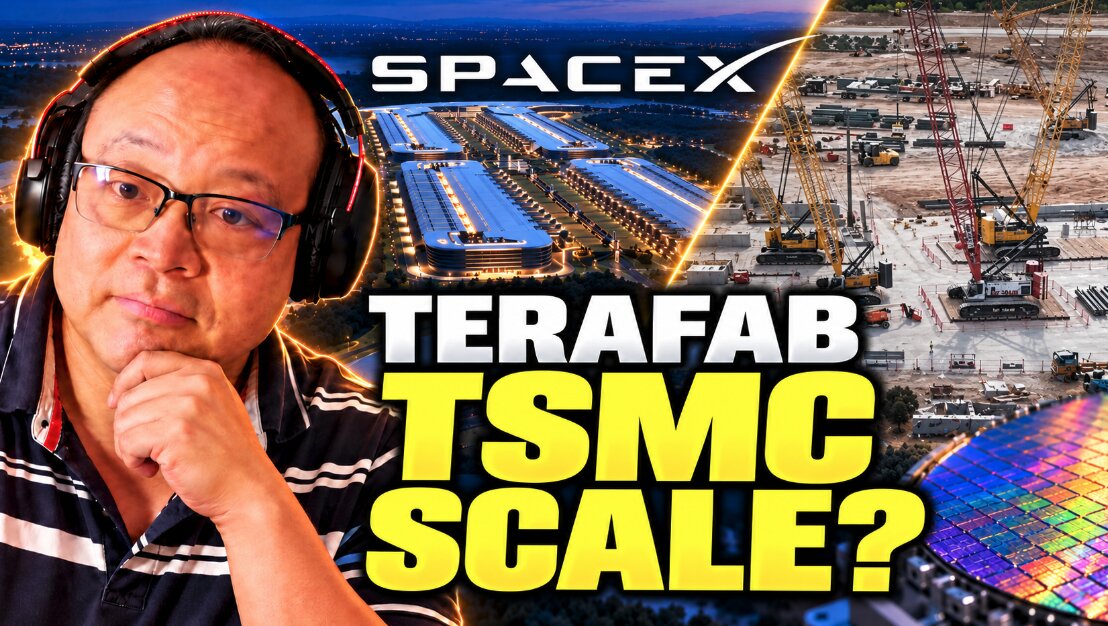
Can SpaceX’s Terafab reach the scale of TSMC? The answer starts with understanding the sequence: develop the process, prove the production line, then replicate it.
The useful question about Terafab is how it gets from a working production line to an enormous chip-manufacturing operation.
That requires a sequence. Acquire the expertise. Develop and qualify the process. Make working chips. Improve yield. Integrate memory and packaging. Then repeat the production system at increasing scale.
My Terafab analysis follows that sequence, from the first development lines to the much longer-term possibility of lunar manufacturing.
Start with what the first fab must prove
A research fab and a high-volume manufacturing campus serve different purposes.
The research operation must establish that the process works and give engineers a way to run experiments, find defects and improve designs. Its value comes from learning and iteration.
The production operation must manufacture useful chips consistently, at an acceptable cost and in enormous quantities.
Confusing those stages leads to bad comparisons. A small development line does not establish the eventual production ceiling. A huge factory building does not establish that its production targets will be achieved.
The bridge between them is a qualified, repeatable manufacturing process.
Elon can assemble capabilities from outside
The strategy I examine is to combine experienced hires, equipment purchases, partnerships, technology licensing and targeted acquisitions.
That is a practical way to approach an industry with decades of accumulated knowledge. The critical question is which capabilities need to be developed internally and which can be obtained from established suppliers and partners.
Buying equipment is only part of the job. A functioning fab also depends on process integration, contamination control, metrology, maintenance and engineers who can diagnose yield problems.
Experienced teams can accelerate that work. They still have to demonstrate results.
Memory and packaging belong in the scaling plan
An AI processor needs memory, interconnections, packaging and testing before it becomes useful computing infrastructure.
A scaling plan therefore has to cover the complete system.
One possible sequence is to secure outside memory supply, develop processor and package designs, build internal packaging and testing expertise, and expand internal manufacturing as processes become qualified.
This gives the project intermediate milestones. It can develop useful capabilities while working toward broader integration.
TSMC scale requires repeatable output
The central scaling question is whether Terafab can establish a production system that can be replicated.
Once a line works, additional lines can potentially reuse its design, operating procedures and engineering knowledge. But replication still requires equipment deliveries, trained workers, utilities, materials and reliable suppliers.
The measure that matters is useful output: good dies, completed packages and functioning systems shipped at a sustainable cost.
Floor space shows room for expansion. Manufacturing performance determines how much of that potential becomes real.
Why the plan eventually reaches the Moon
The lunar portion of the video extends the ambition far beyond the first Earth-based Terafab.
Moving from terawatt-scale annual chip output toward a petawatt-scale scenario implies roughly a 1,000-fold increase in the associated compute-power scale. That would require an industrial system far larger than one campus.
Lunar manufacturing introduces another set of prerequisites: reliable transport, power, construction, materials processing, precision manufacturing and extensive automation.
Early lunar factories would depend heavily on equipment and supplies from Earth. Producing more of their infrastructure locally would be a separate industrial achievement.
Thousands of lunar Terafabs are a long-term scenario whose foundations would have to be built step by step.
Follow the milestones
My case for taking Terafab seriously rests on the possibility of assembling expertise and turning a proven manufacturing process into a repeatable expansion program.
The milestones are concrete: qualified processes, improving yields, dependable memory supply, successful packaging and sustained production growth.
Those are the results that would strengthen the case for TSMC-scale output—and eventually support a much larger vision.
Brian Wang is a Futurist Thought Leader and a popular Science blogger with 1 million readers per month. His blog Nextbigfuture.com is ranked #1 Science News Blog. It covers many disruptive technology and trends including Space, Robotics, Artificial Intelligence, Medicine, Anti-aging Biotechnology, and Nanotechnology.
Known for identifying cutting edge technologies, he is currently a Co-Founder of a startup and fundraiser for high potential early-stage companies. He is the Head of Research for Allocations for deep technology investments and an Angel Investor at Space Angels.
A frequent speaker at corporations, he has been a TEDx speaker, a Singularity University speaker and guest at numerous interviews for radio and podcasts. He is open to public speaking and advising engagements.
Look for disused railway easements and such and put up Butler buildings around them….railways are factories and factories are railways.