
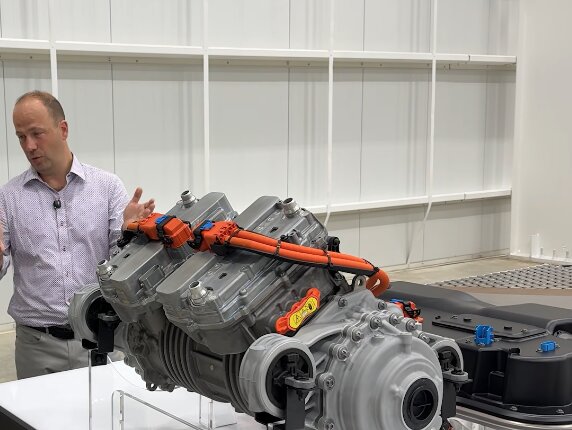
Four 20 kW fans, built on the heat pump’s compressor motor, suck the car onto the road with skirts, so it holds over 2 g in corners even below 50 mph.
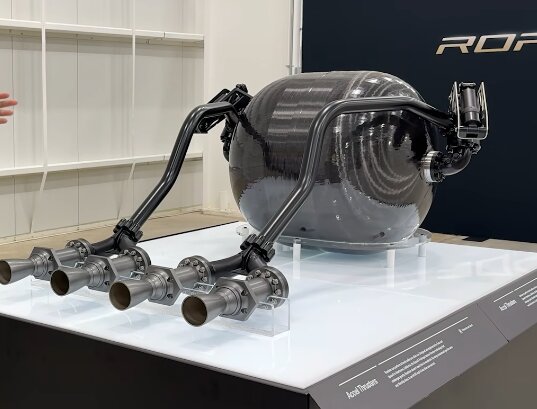
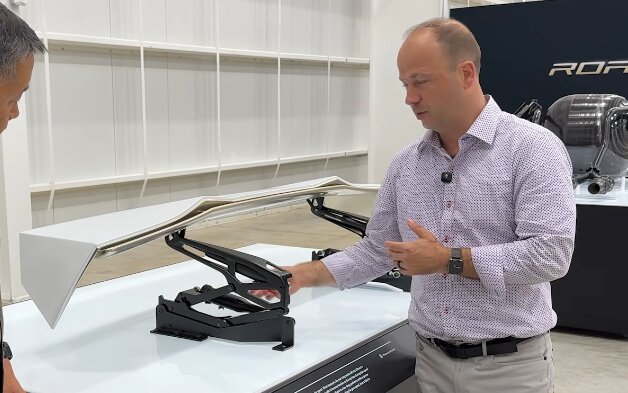
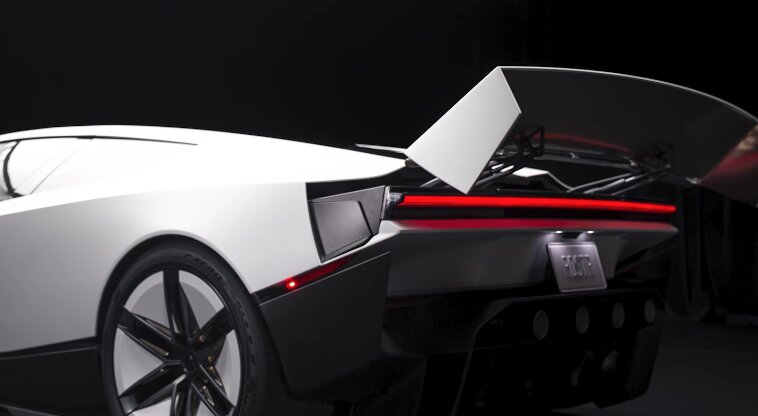
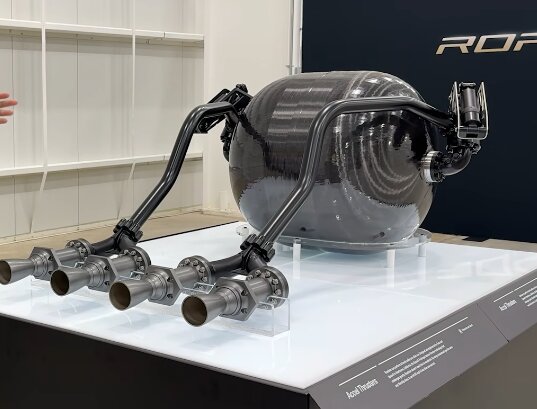
The wing actuators are borrowed Optimus leg actuators. A 200-liter tank at 10,000 psi feeds cold-gas thrusters with more than 80 kN of thrust, about what a single fighter jet engine puts out. 0–60 takes 0.55 seconds as a rollout figure.
0–60 mph in just 0.55 seconds. SpaceX-inspired cold-gas thrusters help deliver this extraordinary acceleration.
A 200-liter carbon-fiber-wrapped pressure vessel behind the seats stores nitrogen at 10,000 PSI.
The thrusters generate 80 kN of thrust, comparable to the thrust of a fighter jet engine!
Instead of burning fuel, the system releases highly compressed nitrogen, using technology inspired by spacecraft propulsion.
Recharging the nitrogen system currently takes 6–7 hours, but Tesla aims to reduce that to just 30 minutes.

Brian Wang is a Futurist Thought Leader and a popular Science blogger with 1 million readers per month. His blog Nextbigfuture.com is ranked #1 Science News Blog. It covers many disruptive technology and trends including Space, Robotics, Artificial Intelligence, Medicine, Anti-aging Biotechnology, and Nanotechnology.
Known for identifying cutting edge technologies, he is currently a Co-Founder of a startup and fundraiser for high potential early-stage companies. He is the Head of Research for Allocations for deep technology investments and an Angel Investor at Space Angels.
A frequent speaker at corporations, he has been a TEDx speaker, a Singularity University speaker and guest at numerous interviews for radio and podcasts. He is open to public speaking and advising engagements.
[ … it would be interesting seeing an infrared spectrum video recording (in parallel to visual spectrum) of one of the presentations with the thrusters and the downforce-supplying ventilators and with recharging the air pressure system? (thx) ]
If it’s nitrogen the cold thrusters need, here’s all the relevant facts:
Suppliers:
Atlas Copco, Parker Hannifin, Air Products, Ingersoll Rand, NOVAIR, Generon, Holtec Gas Systems, OXYMAT
Distributors:
Compressor World, Atlas Machine & Supply
Chinese units cost ~⅓ of US/EU/Japanese equivalents
Purchase costs:
Small (40–500 SCFH, 99–99.5%): $15K–$35K
Medium (500–5,000 SCFH, 99.5–99.99%): $35K–$100K
Large (5,000–100,000 SCFH, 99.9–99.9995%): $100K–$500K+
Example: Atlas Copco NGP50+ ≈ $29,793; Parker NITROSource Compact ≈ $24,085
Maintenance
Routine: $1,000–$1,500/yr
Compressor parts: ~$1,800 every 18 months (small systems)
Service contract: 3–5% of equipment cost/year
Carbon molecular sieve replacement: every 5–8 years
Energy costs
Energy / Running Cost: 0:25–0.7 kWh per m³ of N₂ produced
~$0.05–$0.15 per CCF (100 ft³)
Small system, 8,000 hr/yr, ~5.5 kW → $4,400–$6,600/yr in electricity
Rule of thumb: ~$0.05/m³ vs. ~$0.35/m³ for cylinder gas
Payback: 12–14 months typical
Up to 90% savings vs. purchased gas
All of that I just post is for onsite generation of nitrogen at room temperature using a compressor/pump the is fed ambient air and then uses hollow core carbon molecular sieve to separate the nitrogen from the oxygen, argon, and CO2.
Space Ranger Drop-Troops.
Space Force self-contained re-entry pods, each carrying three ‘Space Rangers’, using the cold-thrusters for precise landing, as well as in-flight anti-air defense avoidance.
Keep a series of modified Starships ‘upward deployed’, as opposed to forward deployed, in lower orbit with shock-troops on standby.
Preposition ten Space Force stations, basically modified Starships, in low orbit, with shock-troops/drop-troops on standby.
Each carrying, say, 5-6 independent 3-person re-entry pods capable of dropping 15-18 troopers total anywhere on Earth within minutes, along with separate equipment pods landing nearby.
With each Starship being deployed for a period of time on-orbit, like a ship at sea.
90 minutes to drop 150-180 ‘Space Rangers’ anywhere on Earth would be a real asset.
And a great TV show.
If you have to make COPVs anyway
Use hexanitrogen
https://www.acsh.org/news/2025/06/27/perfect-rocket-fuel-no-fires-no-chemicals-just-energy-49569
https://onlinelibrary.wiley.com/doi/10.1002/prep.70045
Treat like atomic craft.
The crew compartment at the end of a tower…ringing it. Think pulse Orion except the tower allows longer travel than the typical pusher plate plunger rods
SLS hydrogen tank with Beck’s carbon fiber–all slid into stainless Starship hull for strength.
Sensors would sever/dissolve connections between the manned compartment and the distant tank/engine block with some explosives/mechanical “fuses” designed to fail such that the crew don’t get a fatal shove.
Looking it up, theoretical calculations put it in the same ISP range as Methalox or H2/O2. No real performance advantage, and it has to be stored cryogenically to be stable enough, and is a serious explosion hazard because as a mono-propellant everything you need for it to go boom is unavoidably present at all times.
And it WOULD go boom if subjected to the vibration of a real rocket environment.
The term for “high energy monopropellant” is “explosive”. No real safe way to use it in a rocket, even the slightest thing goes wrong and the rocket detonates.
If you have to build COPVs anyway….
Now I want to see him use hexanitrogen
https://onlinelibrary.wiley.com/doi/10.1002/prep.70045
https://www.acsh.org/news/2025/06/27/perfect-rocket-fuel-no-fires-no-chemicals-just-energy-49569
I’d want an SLS hydrogen tank wrapped with Beck’s carbon fiber…all that slid into a Starship stainless hull for strength.
Treat that tank/engine combo like a reactor—far from the forward manned section on a boom designed to Orion style accordion…or dissolve in places before a rupture could shove unsurvivable gee forces into the crew.
10,000 psi Just like the movie “Steamboy”. The question is which role Elon plays… the father, the grandfather? Is spaceXai the O’Hara Foundation?
Yes, pure nitrogen would smother passersby. Of course there are about a million other legal issues with this thing, but I’ll leave those to others.
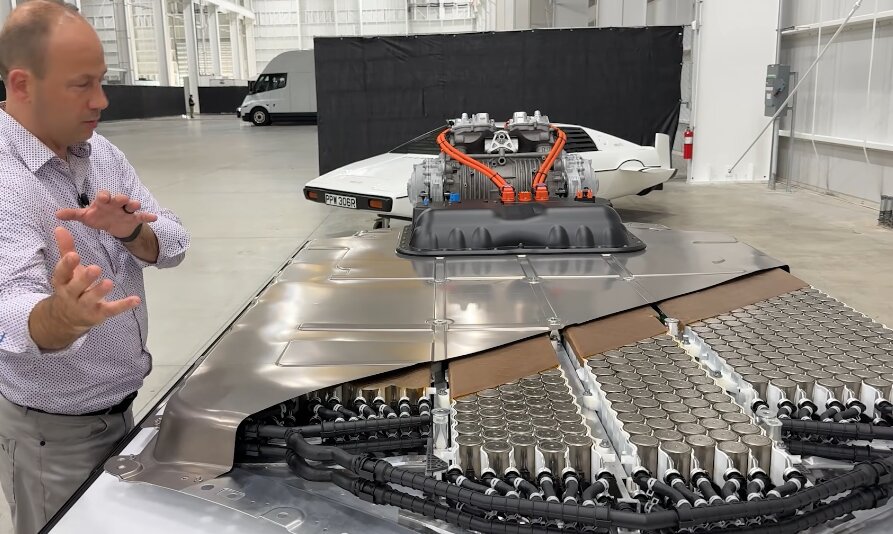
By the way, did you somehow totally overlook, in the second still image above, that Tesla apparently has the James Bond SUBMARINE CAR in their shop?!? The converted Lotus Espirit, from ‘The Spy Who Loved Me,’ was in my opinion the coolest Bond car ever. Tesla showed a brief glimpse of it in their promo video, but I assumed that was a stock image, and never guessed that they had procured the thing! Maybe next gen for Tesla Roadster 3? (I can dream.)
So, Musk watched Supercar as a kid?
Where would they get the nitrogen to compress? It’s likely air, not nitrogen.
It can likely run on both, but you really have to get super dry air, having a valve ice over would ruin your whole day.
[ … micro sieves/’Hollow Fiber Membranes’ (space technology) can filter smth. from the intake air (and nitrogen atoms are quite big, compared to oxygen/carbon dioxide, but that would be very advanced (with that high air intake on limited equipment volume, the rocket version is a one-seater, maybe therefore? The temperature swing for the pressure vessel could be from ~ minus 120-150° to below 75-80°C for the 69Megapascal pressure changes and require special alloy for the nozzles (up to ~ minus 160-190°C, with reduced humidity), with not getting brittle below a -40-70°C also for the valves?
For the safety options (with not avoiding the obstacle ‘on the road’ to surpass sideways/by jumping with 150-200m distance for reaction time and acc. profile/path below a 6-7g) the math. only possibilities from a (only) 370km/h (kinetic energy ~100MJ, ~29kWh) to halt would be a j-turn/180°-reverse impact/’ejector seat’, structural crumple zone in the rear with optimized equipment for that (’empty N2-pressure vessel’)/15-20cm damping slide way for the seat(s), for staying below a 40G, backward acc. spike.
Mach 0.5 (apart from the rubber(?) technology for the wires, for a road ‘car’) is absolutely different for the passenger safety options?
At that speeds, ‘missing the obstacle’ is best option(?).
For the 6-7h refill time that’s probably about 2.5-7.5kW (possibly alm. silent, 200-600l, *20, for the 0.5h requ.?, filter bundle of add. ~30-40kg (fibers up to ~1.5-4-6Megapascal), for the 14m3/min of air input, dew point below -40°C, N2_95%_O2_~5%) for the (staged) power pumps.) (thx) ]
[ … sorry, AI was wrong with calculation on a factor 10 for the kinetic energy (and me not recognizing, yet, 100MJ is more like 710mi/h or 1150km/h): at 370km/h that’s about 10.5MJ (or 2.9kWh) and with SpaceX retro burn, an about 2.4-foot (0.75cm) front automotive modern crumple zone would be enough, with advanced standard safety options (modern seatbelts and smart airbags) remaining 24G for maybe only light injuries? (realistic?) (thx) ]
If nothing else, Hexanitrogen explosives inside a closed lunar lava tunnel will fill it with atmosphere fast—then use the COPVs for “indoor” propulsion.
So cool.