

Tesla robotaxi has passed Waymo in driverless miles in Austin. Elon’s reaction was that it was never a real contest.
718 of the 1080 Texas registered Tesla vehicles are registered for Austin.
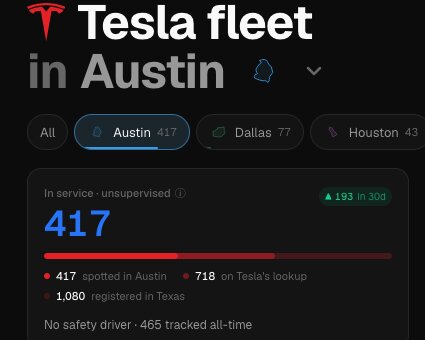
Here are the numbers. Robotaxi Tracker has Tesla at about 438,000 driverless miles a week in Austin, against about 406,000 for Waymo (LIVE). Waymo’s figure is its Q2 2026 weekly average, because Waymo reports about three months after each quarter. Waymo could be higher now. Still, Waymo took about two years to build that lead, and Tesla closed it in months.
I joined Herbert Ong on Brighter with Herbert to go through what comes next.
Cybercab is now the majority of Tesla’s Texas fleet
Texas DMV registrations by VIN show 1,080 Tesla vehicles registered for unsupervised robotaxi service. 573 are Cybercabs and 507 are Model Ys (LIVE, Oct 28, 2026). That is 53% Cybercab.
I think this is a permanent shift. Cybercab is a purpose-built robotaxi, and it is becoming the dominant platform for Tesla robotaxi.
Why Cybercab can ramp so fast
Munro Live toured the Cybercab line.
Unboxed manufacturing. The car is split into modules that are built in parallel and snapped together at the end, like giant Lego.
About 25 final-assembly stations. VP Lars said Model Y had 5 to 10 times more assembly stations.
About half the factory floor space per unit of output.
About half the parts of a Model Y.
Cybercab was also designed for Optimus. That covers helping in the factory, fleet charging and cleaning, light service and possibly even deliveries. Tesla’s entire focus is on reducing the cost per mile. (The Optimus images in the video are illustrations, not real footage.)
Waymo is limited by cars. Tesla is limited by how fast they choose to add them
.Waymo’s miles are tied to its vehicles. It has about 4,000 vehicles in total, with about 500 in Austin. The crowd-sourced tracker counts about 430 Tesla robotaxis in Austin. But it samples only about -.1% to1% of rides, so my estimate of the real number is more like 1200. Both fleets can squeeze only 10–20% more miles out of each car. So more miles means more cars.
The tracker shows Tesla growing about 20% a week. If that holds, cumulative miles go from about 3.3 million to about 15 million, roughly 8X. That needs about 8X more vehicles. 4,000 in Austin alone.
So Brian’s question is: 700+ in Austin now, 4,000+ in 60 days? [VERIFY: 700+ Austin source. The episode only has ~430 tracked and my 500–600 estimate. The 4,000 figure is the 8X Austin math above, and the 60-day window matches the 5,000-vehicles-by-end-of-December target below.]
The fleet ramp: Dallas, Houston and Florida
The crowd tracker shows about 75 vehicles in Dallas, about 40 in Houston and 20–30 in Tampa (LIVE, crowd-sourced, undercounted). I think there are about 300 staged across Dallas and Houston.
Tesla said Cybercab joins the Dallas fleet next month. Houston’s geofence just grew about 10X. Tesla typically adds vehicles within about two weeks of a big geofence expansion. Combined, Tesla’s Texas service area is now about 600 square miles vs about 307 for Waymo.
Turning on a city is about a one-month process: about two weeks to go from 25 to 100 cars, then you add Cybercabs to reach about 400. I expect close to 2,000 vehicles by the end of November or the first week of December (FORECAST). To stay on the 20%-a-week track, Tesla needs about 5,000 vehicles by the end of December (FORECAST). Christmas staffing could push that to mid-January. I expect Tesla to go Texas-wide in Q1.
FSD v15 odds
I put the odds of FSD v15 before the end of the year at about 30%. If it slips, I’d put it at 50–60% by the end of January and 80–90% by the end of February (FORECAST). I think Tesla is already close to it in its own Cybercabs.
Safety, Barclays and hail vs rent
Tesla’s new safety data shows about 6 million miles between major collisions on FSD Supervised, vs about 660,000 for the average US driver (COMPANY). Barclays upgraded Tesla, citing improving vehicle demand, stronger energy growth, accelerating robotaxi adoption and potential SpaceX upside.
Turo now lets you book verified FSD Supervised Teslas. I see two robotaxi models: hail one for a trip, or rent a self-driving car for a week. Tesla will end up offering both. It’s like Airbnb vs a hotel.
Can Tesla pass all of Waymo?
This part is a projection, not a fact. Across all markets, Waymo drove about 3.90 million driverless miles a week in Q2 2026. Tesla’s best week was about 558,000, a 7.0X gap. At 20% a week, Tesla would close that in about 10.7 weeks, roughly 75 days. That only holds if the pace holds. It is measured against Waymo’s older Q2 number, and Waymo is growing too. It is aiming to go from about 4,000 cars to about 8,000.
Austin was no contest. All of Waymo is the next test.

Brian Wang is a Futurist Thought Leader and a popular Science blogger with 1 million readers per month. His blog Nextbigfuture.com is ranked #1 Science News Blog. It covers many disruptive technology and trends including Space, Robotics, Artificial Intelligence, Medicine, Anti-aging Biotechnology, and Nanotechnology.
Known for identifying cutting edge technologies, he is currently a Co-Founder of a startup and fundraiser for high potential early-stage companies. He is the Head of Research for Allocations for deep technology investments and an Angel Investor at Space Angels.
A frequent speaker at corporations, he has been a TEDx speaker, a Singularity University speaker and guest at numerous interviews for radio and podcasts. He is open to public speaking and advising engagements.
Do we know what ‘4,000 vehicles’ actually means in a city like Austin? What proportion of the Uber and traditional taxi services market is covered by 4,000 robotaxis? Is there a statistic about Uber rides in a city? And does the number go down if Waymo or Tesla add more vehicles?
There are about 10000 Uber and Lyft drivers and cars in Austin. Uber, Lyft and taxis would get impacted by a big Tesla rollout.