

AI could enable businesses—and eventually entire industries—to achieve tenfold or greater productivity with the same workforce. That would change the cost of goods and services, the value of skills, and which companies dominate.
The Industrial Revolution shows how transformations of that scale develop. It also explains why impressive inventions can arrive long before their full economic impact.
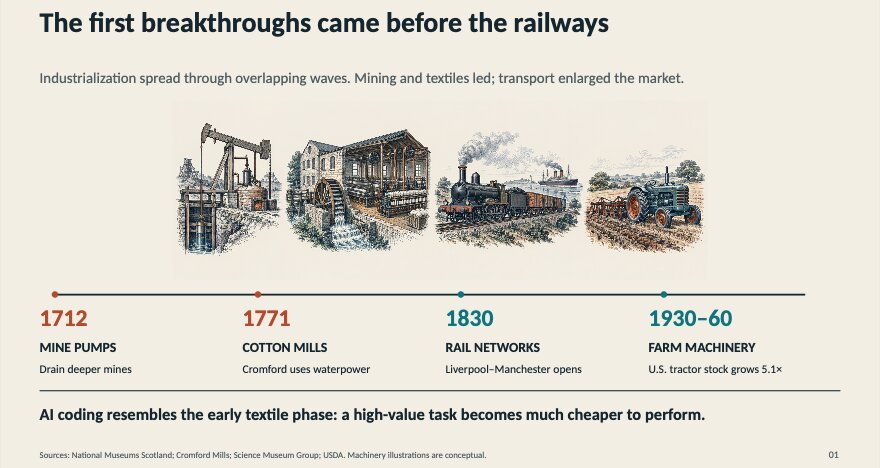
The invention is only the beginning
Cotton machinery increased the amount of material workers could process. But expanding production required improvements across multiple stages. Faster spinning created demand for more weaving capacity. Growing factories needed power, supplies, transportation, and customers.
Railroads expanded the markets those factories could serve. Cheaper transportation and larger production volumes reinforced each other.
The economic transformation emerged as these capabilities spread and worked together. A breakthrough in one machine was an opening for further investment and reorganization.
Why faster AI can produce disappointing business results
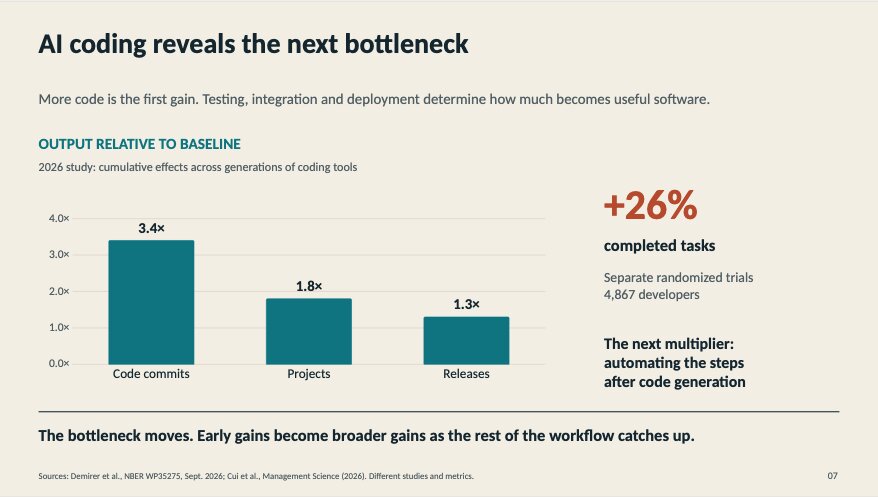
A business can generate code faster and still wait on testing, approvals, integration, and deployment.
Consider a simple example. If one task accounts for 20% of a sequential workflow, making that task ten times faster reduces total work time from 100 units to 82. The overall speedup is approximately 22%, even though the individual task improved tenfold.
This is why the extent of automation matters. The remaining slow steps increasingly determine the result.
Businesses seeking much larger gains must redesign the workflow, connect the automated steps, and maintain the quality of the final output.
The next opportunity is removing the constraint
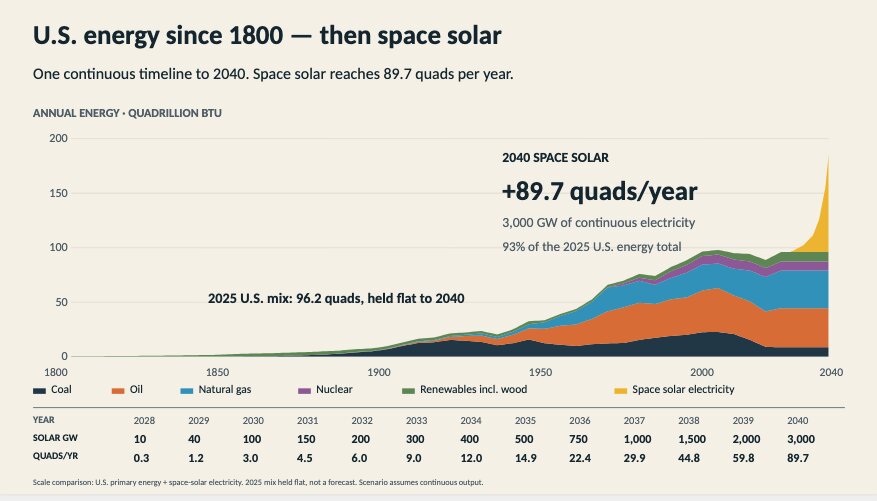
In my discussion with Randy Kirk, we connect this historical pattern to AI agents, robotics, energy, computing infrastructure, and SpaceX.
Digital workers require chips and electricity. Physical automation requires reliable machines and deployment. Expanding space infrastructure requires launch capacity. Progress in one area can create demand—and opportunities—in another.
History gives us useful questions to ask
How much cheaper is each completed, useful task?
How much of the full workflow is automated?
What now limits output?
How quickly can production capacity expand?
For businesses, these questions help identify where to invest and reorganize. For workers, they help reveal which skills become more valuable as routine tasks become cheaper.
The AI industrial revolution will be measured in useful output: completed work, lower costs, and capabilities that become affordable at scale.
Understanding how earlier transformations unfolded helps us recognize what must happen to unlock this one.

Brian Wang is a Futurist Thought Leader and a popular Science blogger with 1 million readers per month. His blog Nextbigfuture.com is ranked #1 Science News Blog. It covers many disruptive technology and trends including Space, Robotics, Artificial Intelligence, Medicine, Anti-aging Biotechnology, and Nanotechnology.
Known for identifying cutting edge technologies, he is currently a Co-Founder of a startup and fundraiser for high potential early-stage companies. He is the Head of Research for Allocations for deep technology investments and an Angel Investor at Space Angels.
A frequent speaker at corporations, he has been a TEDx speaker, a Singularity University speaker and guest at numerous interviews for radio and podcasts. He is open to public speaking and advising engagements.