Better Accelerators to Produce Kilograms of Isotopes for Fast Space Propulsion

There is technology being perfected to make particle accelerators 100-1000 times lower cost. This would enable production of nuclear material for space propulsion that could reach up to 0.5% of light speed or more. Scientists at DESY now report some of the first signs that PWA (Plasma Wakefield Accelerators) is ready to compete with traditional …

Read more

Thin Film Nuclear Rocket With Californium for Fast Gravitational Lensing Missions

Jim Bickford is leading the Thin Film Isotope Nuclear Engine Rocket (TFINER) project to develop a system for propelling a craft through space faster and farther than ever before. This technology has the potential to enable speeds of 0.5% of light speed and near term capability for 0.1% of light speed. This would be ten …

Read more

Thin Film Nuclear Propulsion

NASA NIAC funded the Thin-Film Nuclear Engine Rocket (TFINER). By May 2025, it advanced to Phase II, focusing on maturing the technology, mission designs, small-scale thruster experiments, and isotope production pathways in collaboration with Northwestern University, Yale University, Los Alamos National Laboratory, and NASA Marshall Space Flight Center (MSFC) for hybrid architectures. A single stage …

Read more

Nuclear Salt Water Rocket a Delicate Balance of Supercritical Nuclear Explosions

There are some potentially valid criticism about the Nuclear Salt Water Rocket (NSWR). The criticisms highlight real physical constraints. A hydrogenous mixture will moderate neutrons, preventing a fast-spectrum detonation and likely limiting the reaction to a thermal fizz. However, Zubrin’s NSWR isn’t necessarily aiming for a weapons-grade explosion but rather a controlled, continuous supercritical reaction. …

Read more

Centrifugal Magnetic Mirror Nuclear Fusion Propulsion

Centrifugal Magnetic Mirrors could enable commercial nuclear fusion reactors on Earth and are also promising for next level propulsion in space. There is funded near term work for both goals. An early Centrifugal Magnetic Mirror propulsion concept could achieve 1 to 10 newtons of thrust with 10,000 to 30000 ISP. This would be propulsion that …

Read more

Exodus Propulsion Propellentless Drive Gets Mainstream Coverage

Three months ago, Nextbigfuture covered Exodus Propulsion’s claim of a huge space propulsion breakthrough. They claim they can produce over 1G of thrust for a lightweight device. IF this claim is true then they could make spaceships that could go to Mars in 5 days and reach near light lightspeed in a year. They would …

Read more

Exodus Propulsion Technologies Claims Huge Space Propulsion Breakthrough

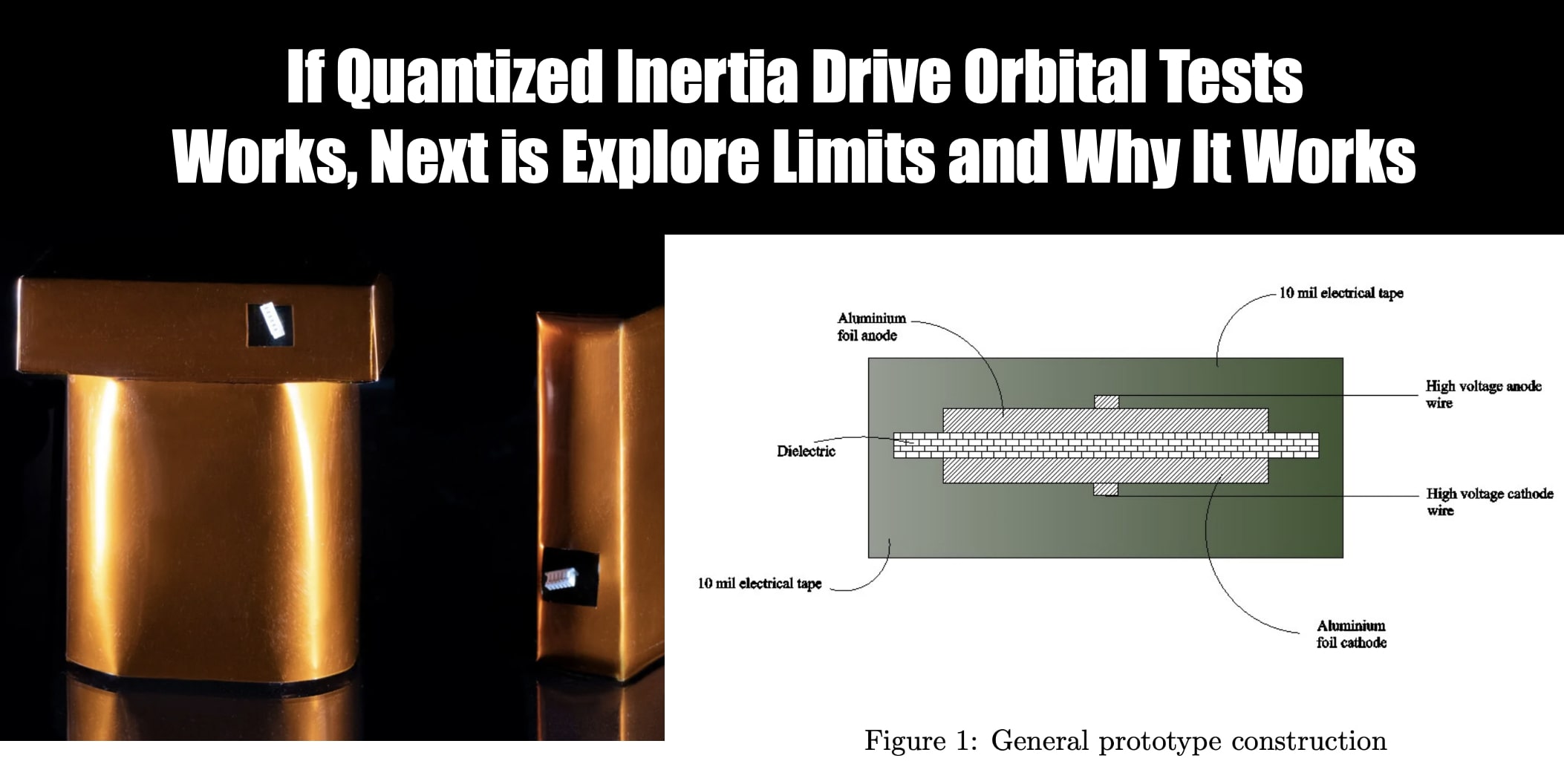
Dr. Charles Buhler and Exodus Technologies claims that systems with electrostatic pressure differences or electrostatic divergent fields gives systems with a center of mass with non-zero force component (aka generate movement). Buhler is NASA’s subject matter expert on electrostatics. They want to move to demo the system in orbit. These kinds of claims are controversial …

Read more

Rocketstar Aneutronic Fusion-enhanced Electric Pulsed Plasma Propulsion Will Be Tested in Orbit

RocketStar, a US based startup, has successfully demonstrated an electric propulsion unit for spacecraft that uses nuclear fusion-enhanced pulsed plasma. During ground tests the process did create ionizing radiation and improved the base propulsion unit’s thrust by 50%. FireStar Drive markedly improves performance, utilizing high-speed protons from ionized water vapor. When protons interact with boron …

Read more

What We Still Would Not Know IF IVO Quantized Inertia Drive Works in Orbit

The IVO quantum inertia drive is in orbit now and will be turned on within one to ten weeks and then operated for many weeks or months. The IVO quantum inertia drive is very controversial because it would go against many theories in physics. Let us assume the 52 millinewton drive using 1 watt of …

Read more

Optimized Nuclear Thermal Rocket for 45 Days to Mars

Nuclear Thermal Propulsion (NTP) is the preferred propulsion technology for manned missions throughout the solar system. The state-of-the-art NTP cycle is based on solid core Nuclear Engine for Rocket Vehicle Application (NERVA) class technology that is envisioned to provide a specific impulse (Isp) of 900 seconds doubling chemical rocket performance (450 seconds). Even with this …

Read more

2011 NASA NIAC Fission Fragment Rocket Design

Early 2011, NASA NIAC study of fission fragment propulsion. Brian WangBrian Wang is a Futurist Thought Leader and a popular Science blogger with 1 million readers per month. His blog Nextbigfuture.com is ranked #1 Science News Blog. It covers many disruptive technology and trends including Space, Robotics, Artificial Intelligence, Medicine, Anti-aging Biotechnology, and Nanotechnology. Known …

Read more