Alphafold is Evidence of a Computational Universe

Standard view treats physics as fundamental — matter, energy, fields — with information as merely a description we lay on top. Google Deepmind Demis Hassabis inverts this. Prior physicists John Wheeler’s “it from bit”, Konrad Zuse’s and Ed Fredkin’s digital physics also view information and computation are the bedrock. Matter/energy are what information looks like …

Read more

Technology and Plan for the Next 100K SpaceX Multi-Gigabit Satellies

SpaceX have filed for a 100,000 satellite Gen3 NGSO system. The satellites will be 2000-2500 kg, area 300 to 400 sq m. Orbits 320-480 km at various inclinations. The FCC application says the Gen3 constellation will deliver extremely low-latency, multi-gigabit symmetrical throughput. And the sheer number of satellites will ensure multiple satellites are always visible …

Read more

Speculations on What Could Show Physics Beyond the Standard Model

Post-spacetime physics refers to the idea that our familiar 4D spacetime is not fundamental but emerges from deeper structures—whether geometric (fiber bundles, higher-dimensional manifolds), quantum (entanglement, information), or vacuum effects. Eric Weinstein’s Geometric Unity (GU) proposes a 14-dimensional geometric framework (involving a metric bundle over 4D spacetime) from which the Standard Model forces, gravity, and …

Read more

Casimr Microsparc Nanostructure Technology Taps More Than Chemical or Nuclear Energy

Sonny White and the Casimir Team have created nanostructures to get microwatts of continuous energy (could last centuries or millenia) by leveraging the Casimir force. In Casimr Energy there are fewer virtual particles between plates with a tiny gap which creates a force by having more virtual particles outside it. The first-generation microsparc delivers performance …

Read more

Casimir Microsparc Target is 40 Microwatts of Continuous Vacuum Energy- One Way Electron Flow

A prototype MicroSparc chip was fabricated, the Casimir team tests it using low-noise experimental setups designed to reduce electromagnetic interference. Dr. White said these tests were performed in dark, RF (radio frequency)-sealed enclosures over several weeks “using precision electrometers capable of measuring signals down to microvolt and attoamp sensitivities.” They observed device outputs ranging from …

Read more

Heat Radiators for AI Data Centers in Space Will Be a Huge Advantage and Not a Huge Problem

There were many complaints that radiating heat from AI Data Centers in space would be a huge problem but in fact they will be a huge advantage. On Earth, cooling an AI data center is an active, energy-hungry process. Chillers, fans, pumps, water loops, and heat exchangers devour power simply to stop silicon from melting …

Read more

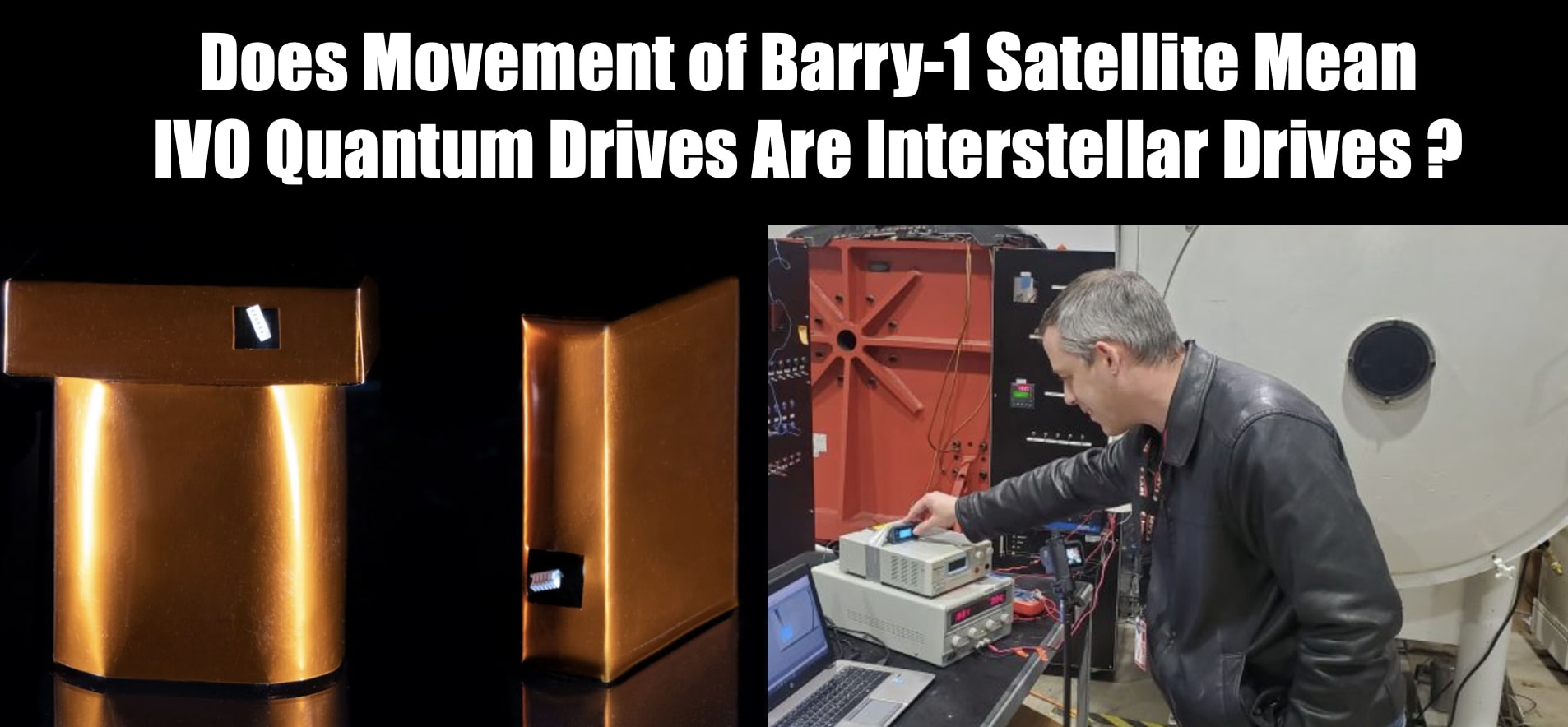
Exodus Propulsion and the Exodus Force aka Electrostatic Pressure Force

NASA’s Lead Electrostatics Scientist, Dr Charles Buhler, claims he’s discovered a “new force” that counteracts gravity with no fuel necessary. Dr. Charles Buhler has run 2,000 vacuum chamber experiments showing a propellantless thrust force that persists after the power is switched off, and cannot be explained by ion wind, magnetic effects, or classical energy conservation. …

Read more

SpaceX Has the Best Radiative Cooling Solution and It is Working

SpaceX already has over 10,000 Starlink satellites in space and the majority are version 2 mini. They already have 10-15 Kilowatts of electricity each. They generate that with solar power (z-fold solar panels). They have to radiate the heat generated. Solar power gets collected and becomes 10+ kilowatts of electricity. It is used by the …

Read more

Startup Substrate Could Enable the Age of XRay Lithography for sub-Nanometer Chips

Startup Substrate is building next-generation semiconductor fabs using advanced X-ray lithography. This goes beyond extreme ultraviolet 13.5 nanometer wavelengths down to 0.01 nanometers. At the core of Substrate’s technology is a custom particle accelerator which propels electrons (produced by an unknown emitter) to near the speed of light using radio-frequency cavities. As these electrons pass …

Read more

SpaceX Starlink and Samsung Develop AI-powered Modem

Recent announcements highlight Samsung’s development of an AI-powered modem chip designed to enable direct satellite-to-device (D2D) connectivity with SpaceX’s Starlink constellation. This chip uses AI to optimize signal processing, beamforming, and interference management, allowing unmodified smartphones and devices to connect to low-Earth orbit (LEO) satellites at gigabit speeds—even indoors or through obstacles like buildings and …

Read more

Better Accelerators to Produce Kilograms of Isotopes for Fast Space Propulsion

There is technology being perfected to make particle accelerators 100-1000 times lower cost. This would enable production of nuclear material for space propulsion that could reach up to 0.5% of light speed or more. Scientists at DESY now report some of the first signs that PWA (Plasma Wakefield Accelerators) is ready to compete with traditional …

Read more