All Organic Building Blocks of Life Likely Form Naturally in Space

Organic molecules delivered from extraterrestrial materials may have played a key role in supplying building blocks for life on Earth. Scientists have found all five canonical nucleobases—purines (adenine and guanine) and pyrimidines (cytosine, thymine and uracil)—in samples returned from the C-type asteroid (162173) Ryugu by JAXA’s Hayabusa2 mission. This likely means that organic molecule building …

Read more

Asteroid Threat Detection and Planetary Defense Can Be Complete and Ready by 2035

We need an enhanced version of SUNSET to establish a space-based, combined discovery and early-warning system for NEOs (Near Earth Objects). If we use multiple satellites traveling ahead of Earth on its orbit we improve detections of sunward objects over satellites in NEO-Surveyor-like orbits by tens of percent and enables seamless, automatic follow-ups. A University …

Read more

Astroforge Raised $40 Million for Asteroid Mining

AstroForge announced it has raised $40 million in a Series A funding round led by Nova Threshold, including investments from 776, Initialized, Caladan, YC, Uncorrelated Ventures, and Jed McCaleb. The funding brought AstroForge’s total capital to $55 million. AstroForge has several upcoming missions, including the development of its third mission, Vestri. Scheduled to launch in …

Read more

Earth Extinction Sized Comets

NASA has a catalog of many large comets and some of them are nearly as large or larger than the Chicxulub impactor (Dinosaur killer). Comet 109P/Swift-Tuttle takes 133 years to orbit the Sun once. Swift-Tuttle last reached perihelion (closest approach to the Sun) in 1992 and will return again in 2125. Swift-Tuttle is a large …

Read more

PI Planetary Asteroid Defense

Philip Lubin has been funded by NASA NIAC to study a practical and effective method of planetary asteroid defense that allows for extremely short mitigation time scales if required. The method involves an array of small hypervelocity kinetic penetrators that pulverize and disassemble an asteroid or small comet. This effectively mitigates the threat using the …

Read more

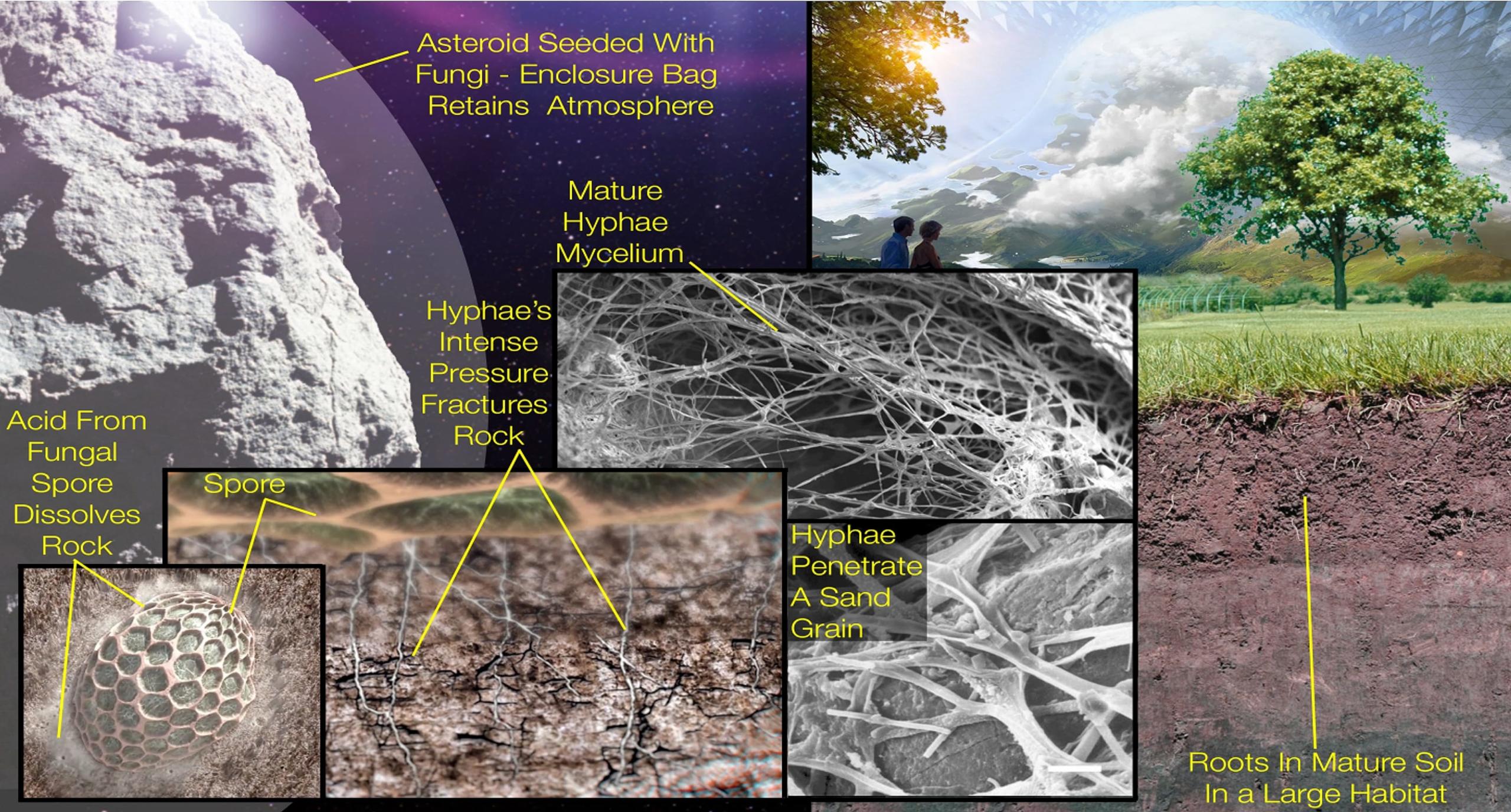
Great Space Farming With Great Soil on Asteroids With Fungi

A Phase 1 NASA NIAC study proposes to create soil from carbon-rich asteroid material, using fungi to physically break down the material and chemically degrade toxic substances. They will use fungi to help turn asteroid material into soil. The basic idea is to inoculate carbonaceous asteroid material with fungi to initiate soil formation. Fungi are …

Read more

A Sunlight Shifted Asteroid Might Hit the Earth in 2068 with a 1200 Megaton Impact

Dave Tholen and collaborators have detected light from the sun is moving the 300 meter near-Earth asteroid Apophis by 170 meters per year. This acceleration means that Apophis might hit the earth in 2068. Detailed analysis on the next close pass in 2029 will determine if Apophis is a risk. The Sentry Risk Table estimates …

Read more